 Question Constellation Sign up for free
 AQA · GCSE · Biology · Higher
Potato Osmosis Investigation Method
A student investigated the effect of concentration of salt solution on the mass of uncooked potato pieces. Figure 4 shows the results.
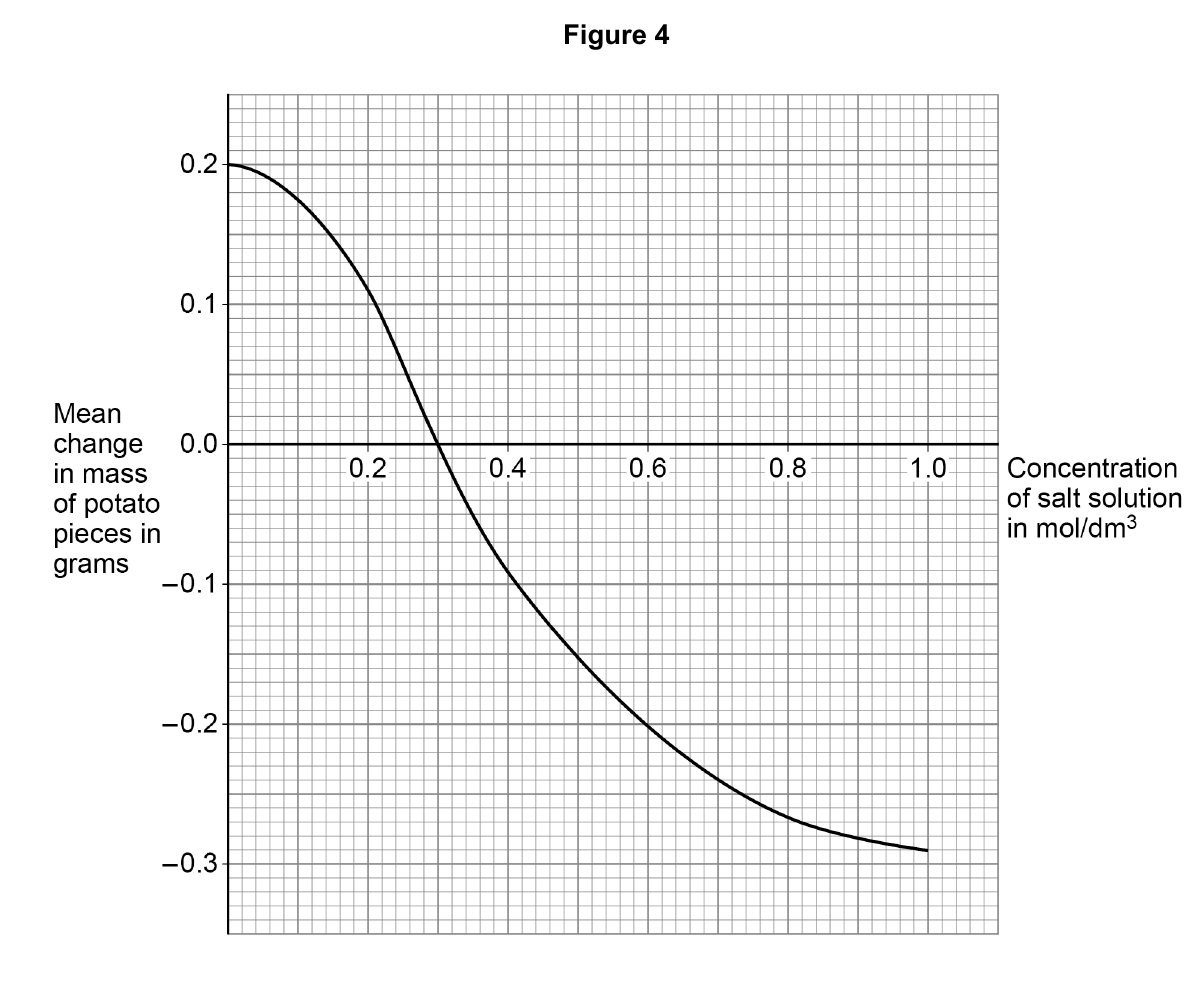
Plan a method that could be used to obtain the results in Figure 4.
Write your answer first. You can study the marking guidance whenever you need it.
Study the marking See what earns credit and compare it with a full-mark answer.
Marking points
- 1 Describes a valid sequence for obtaining initial and final masses and calculating change in mass across a range of salt concentrations.
- 2 Uses repeats and means so the plotted values can be reliable.
- 3 Controls relevant potato, timing, temperature and blotting variables so concentration is the tested factor.
Full-mark answer
Cut equal-sized pieces from the same peeled potato and record each initial mass. Put pieces into a range of at least three salt concentrations, using the same volume of solution, temperature and immersion time for every piece. Remove each piece, blot it dry in the same way, and record its final mass. Calculate final mass minus initial mass. Repeat each concentration at least three times, calculate the mean change in mass, and plot mean change in mass against salt concentration.
Why this answer loses marks
Put potato pieces in salt solutions and see what happens.
This lacks baseline and final measurements, blotting, a calculated mass change, repeats and controlled conditions.