 Question Constellation Sign up for free
 AQA · GCSE · Biology · Higher
Potato Mass Loss by Osmosis
A student investigated the effect of concentration of salt solution on the mass of uncooked potato pieces. Figure 4 shows the results.
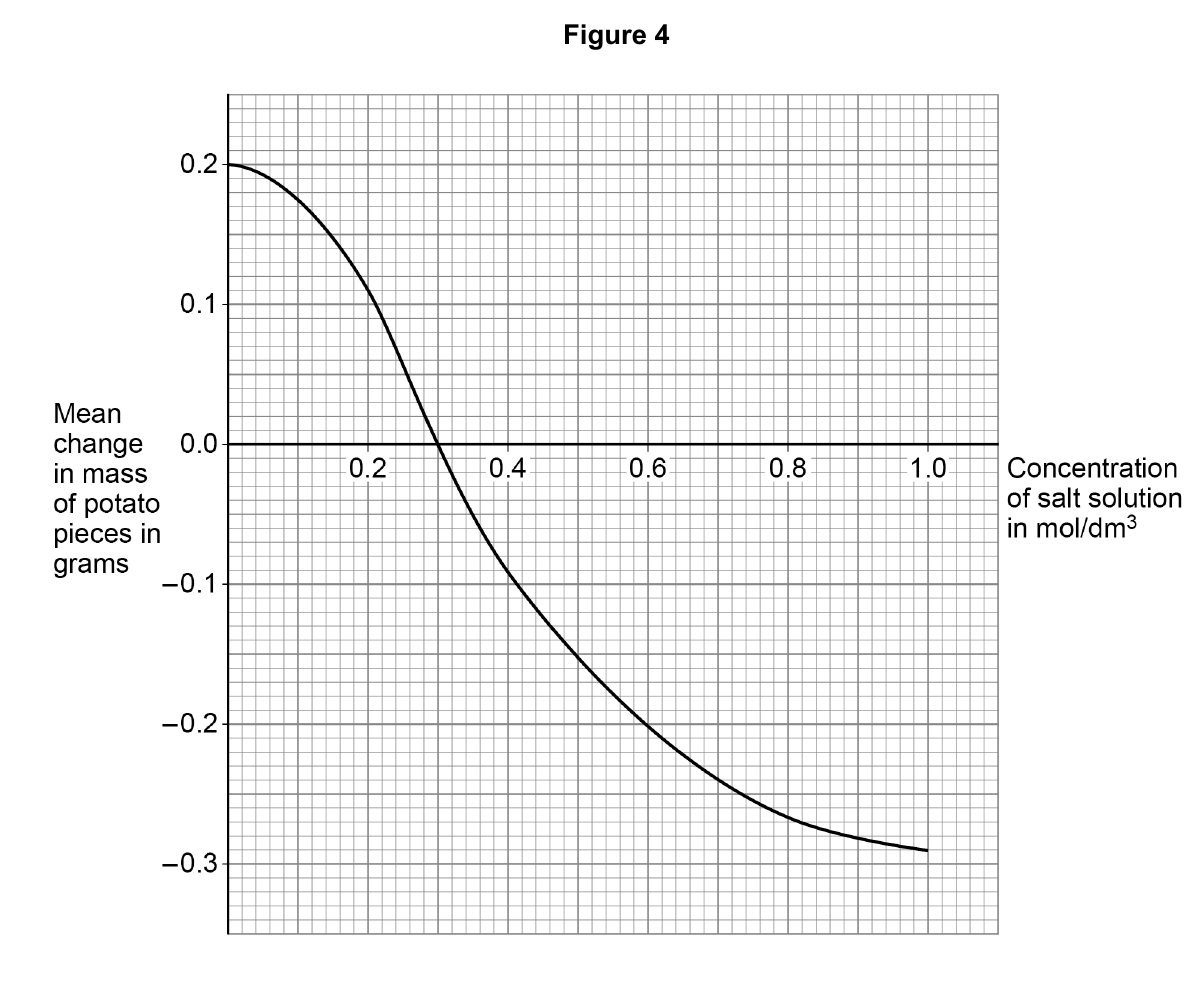
Explain the result for the potato pieces in the 0.6 mol/dm³ salt concentration.
Write your answer first. You can study the marking guidance whenever you need it.
Study the marking See what earns credit and compare it with a full-mark answer.
Marking points
- 1 Explains that the negative mass change means water left the potato cells.
- 2 Correctly compares the concentration, dilution or water potential inside and outside the cells.
- 3 Identifies osmosis, or the allowed diffusion-through-a-partially-permeable-membrane wording.
Full-mark answer
At 0.6 mol/dm³ the solution outside the potato cells was more concentrated than the solution inside them. Water therefore moved out through the partially permeable cell membranes by osmosis, so the pieces lost mass.
Why this answer loses marks
Salt moved into the potato by osmosis.
Osmosis is water movement; compare the concentrations and link water leaving the cells to mass loss.