 Question Constellation Sign up for free
 AQA · GCSE · Biology · Higher
Antibiotic Inhibition Zones
The scientist grew one type of bacterium on agar in a Petri dish. The scientist placed paper discs each containing a different antibiotic on the agar. Figure 5 shows the appearance of the Petri dish after 2 days.
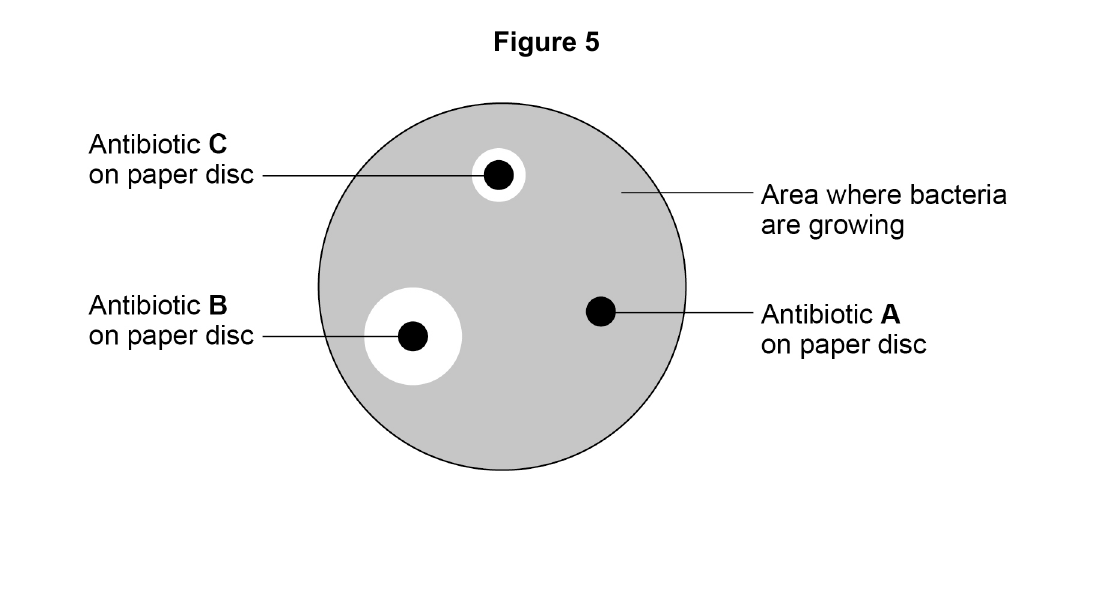
A student said: ‘The bacterium is resistant to antibiotic C.’
Explain how the results in Figure 5 show that the student is not correct.
Write your answer first. You can study the marking guidance whenever you need it.
Study the marking See what earns credit and compare it with a full-mark answer.
Marking points
- 1 Uses the clear zone around antibiotic C as evidence that the bacterium was killed.
- 2 Contrasts this with resistance, which would produce growth up to the disc/no inhibition zone.
Full-mark answer
There is a clear zone of inhibition around antibiotic C, so C killed bacteria near the disc. If the bacterium were resistant, it would grow right up to the disc and no clear zone would form.
Why this answer loses marks
There is a white area around the disc.
A colour description is not enough; identify a zone where bacteria did not grow and contrast it with resistant growth.