 Question Constellation Sign up for free
 AQA · GCSE · Biology · Higher
Temperature and Carbon Dioxide Effects
Light, carbon dioxide and temperature are limiting factors of photosynthesis. Figure 7 shows how the rate of photosynthesis is affected by light, carbon dioxide and temperature.
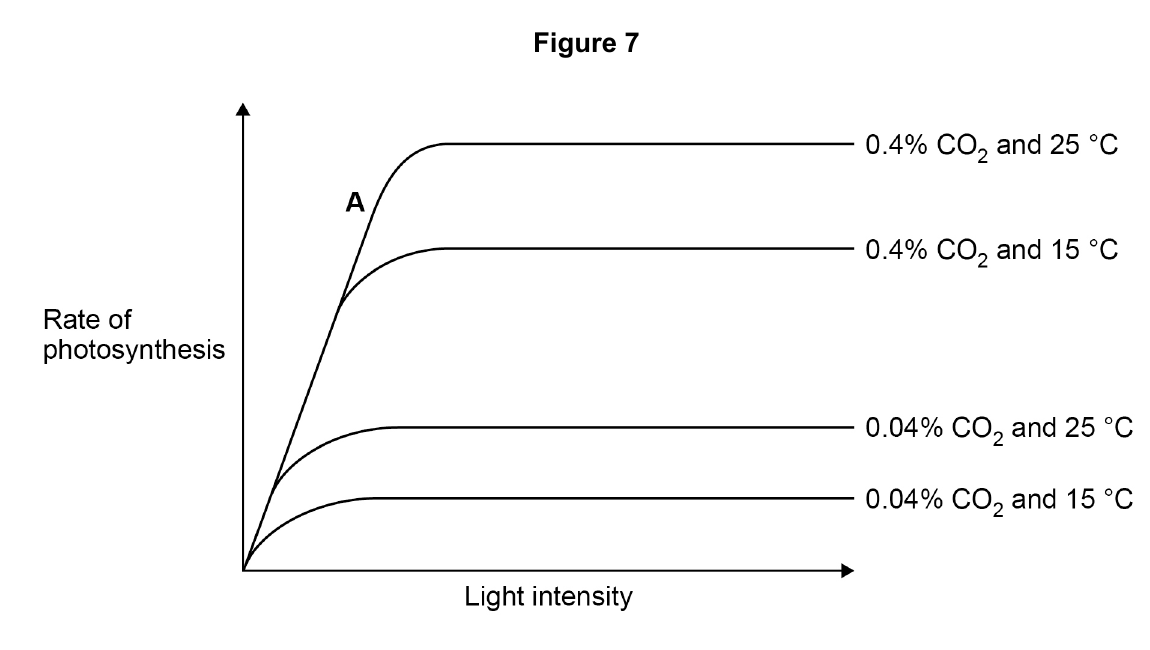
Explain the effect of increasing temperature and increasing carbon dioxide concentration on the rate of photosynthesis shown in Figure 7.
Write your answer first. You can study the marking guidance whenever you need it.
Study the marking See what earns credit and compare it with a full-mark answer.
Marking points
- 1 Uses the graph to state that increasing temperature and/or carbon dioxide increases photosynthesis rate when the other variable is controlled.
- 2 Explains the temperature effect through kinetic energy, movement, collisions or enzyme activity.
- 3 Explains the carbon-dioxide effect as an increase in substrate/reactant concentration.
- 4 Explains the plateau using another limiting factor, not light.
Full-mark answer
At a fixed carbon-dioxide concentration, raising the temperature from 15 °C to 25 °C increases the rate because particles have more kinetic energy, so enzyme-controlled reactions occur faster. At a fixed temperature, raising carbon dioxide from 0.04% to 0.4% increases the concentration of a photosynthesis reactant and increases the rate. Each curve eventually levels off because a different factor then limits photosynthesis.
Why this answer loses marks
Higher temperature and carbon dioxide always increase the rate.
This gives a trend but omits the enzyme-collision and substrate mechanisms, and misses the plateau when another factor limits.