 Question Constellation Sign up for free
 AQA · GCSE · Biology · Higher
Magnification from Cylinder Volume
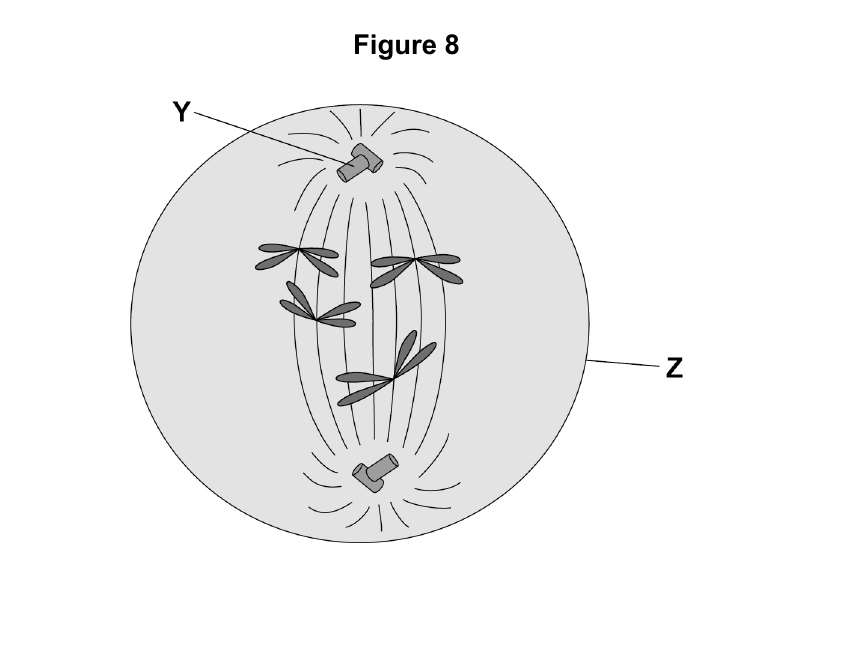
Structure Y in Figure 8 is a cylinder. For structure Y:
- real volume = 24 500 000 nm³
- real radius = 125 nm
The length of a cylinder is calculated using the equation:
The length of the image of structure Y in Figure 8 is 4 mm.
Calculate the magnification of structure Y in Figure 8.
Use π = 3.14
Write your answer first. You can study the marking guidance whenever you need it.
Study the marking See what earns credit and compare it with a full-mark answer.
Marking points
- 1 Substitutes the given volume and radius correctly and obtains the real cylinder length.
- 2 Uses magnification = image size/real size and converts the image length to compatible units.
- 3 Divides the converted image size by real size and reports approximately ×8010 without a unit.
Full-mark answer
First find the real length: 24 500 000 ÷ (3.14 × 125²) = 499.363 nm. Convert the image length: 4 mm = 4 000 000 nm. Magnification = image size ÷ real size = 4 000 000 ÷ 499.363 = 8010.205, so the magnification is approximately ×8010.
Why this answer loses marks
I divided the image size by the value in the figure without converting units.
The denominator must be the calculated real length, and both sizes need matching units before image divided by real.