 Question Constellation Sign up for free
 AQA · GCSE · Biology · Higher
Peat bog decay conditions
Peat bogs are estimated to contain twice as much carbon as all the world's forests. Figure 2 shows a section through part of a peat bog.
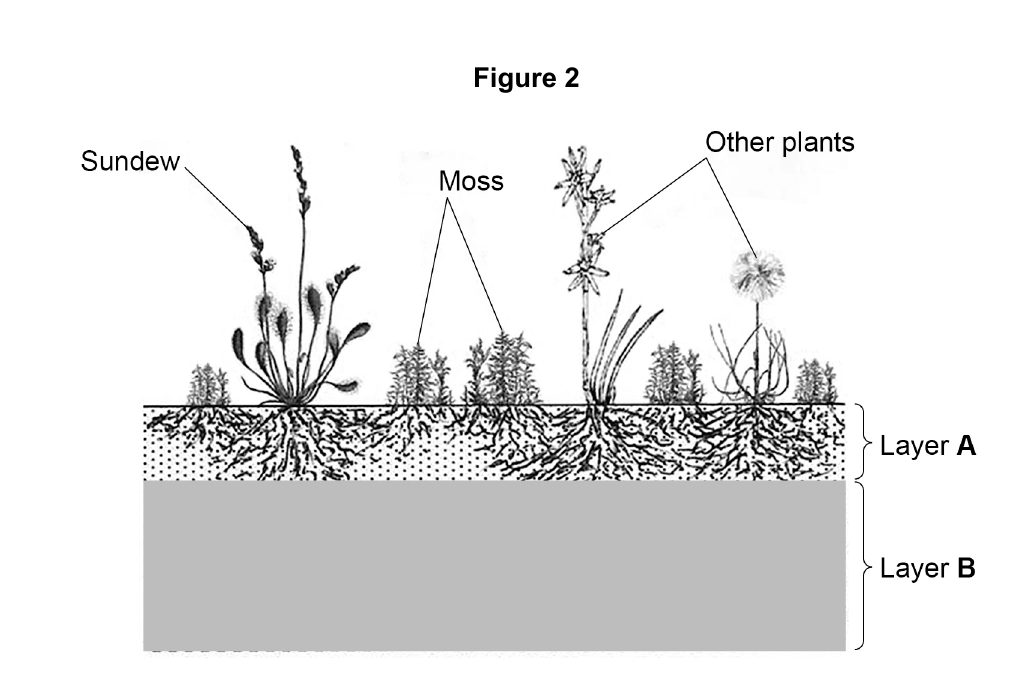
Layer A contains a lot of air.
- contains the dead remains of plants
- has a low pH
- contains very little oxygen
- contains carbon dioxide and methane
Explain why most of the dead remains of plants in layer B do not decay.
Write your answer first. You can study the marking guidance whenever you need it.
Study the marking See what earns credit and compare it with a full-mark answer.
Marking points
- 1 Uses the low-oxygen route: little oxygen for aerobic respiration.
- 2 Links the low-oxygen route to less/no energy released.
- 3 Links the low-oxygen route to reduced decomposer activity.
- 4 Uses the alternative low-pH route: enzymes are denatured or less active.
- 5 Links the low-pH route to reduced reactions/metabolism/respiration or energy release.
- 6 Links the low-pH route to reduced decomposer activity.
Full-mark answer
Layer B contains very little oxygen, so decomposer microorganisms cannot carry out much aerobic respiration. Less energy is released for their activity, so they break down the dead plant remains very slowly.
Why this answer loses marks
The dead plants do not decay because the bog is acidic.
Low pH alone is not enough; link it to reduced enzyme activity, fewer reactions and limited decomposer activity.