 Question Constellation Sign up for free
 AQA · GCSE · Biology · Higher
Pedigree evidence for heterozygosity
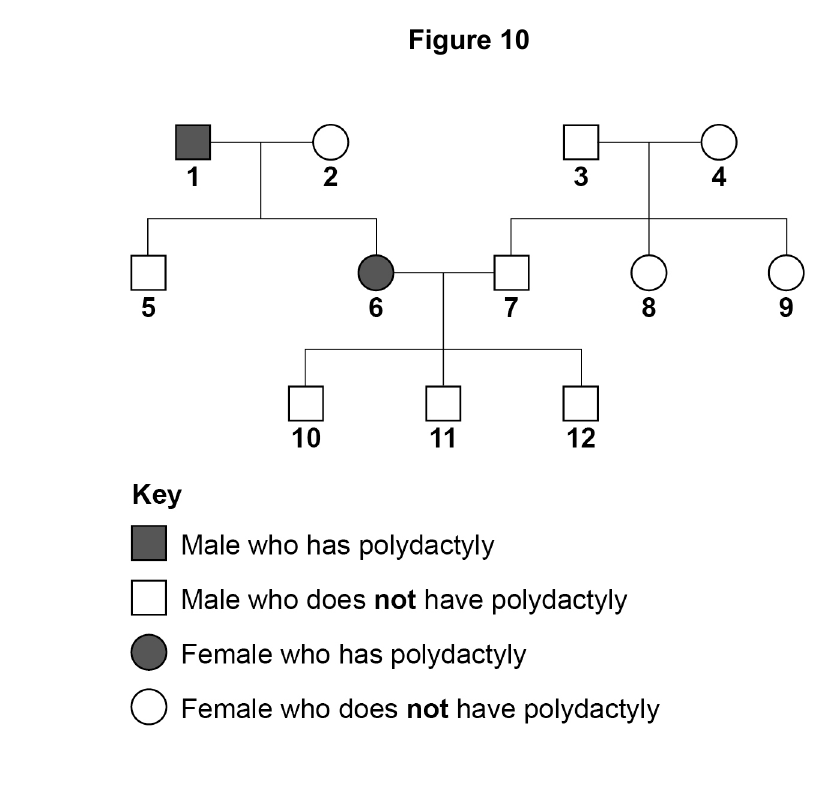
Polydactyly is an inherited disorder caused by a dominant allele. Figure 10 shows the inheritance of polydactyly in one family.
Key
- D
- allele for having polydactyly
- d
- allele for not having polydactyly
Person 1 is heterozygous. Explain how Figure 10 shows that person 1 is heterozygous.
Write your answer first. You can study the marking guidance whenever you need it.
Study the marking See what earns credit and compare it with a full-mark answer.
Marking points
- 1 Uses person 1's polydactyly phenotype to infer a D allele.
- 2 Uses unaffected child 5 (dd) to infer that person 1 also supplied a d allele.
Full-mark answer
Person 1 has polydactyly, so he has a D allele. Person 5 does not have polydactyly and must be dd, so person 5 inherited a d allele from person 1. Person 1 is therefore Dd.
Why this answer loses marks
Person 1 is affected, so they must be heterozygous.
Being affected shows a dominant allele but not the recessive one; the unaffected child proves the recessive allele was passed on.