 Question Constellation Sign up for free
 AQA · GCSE · Biology · Higher
Punnett square inheritance probability
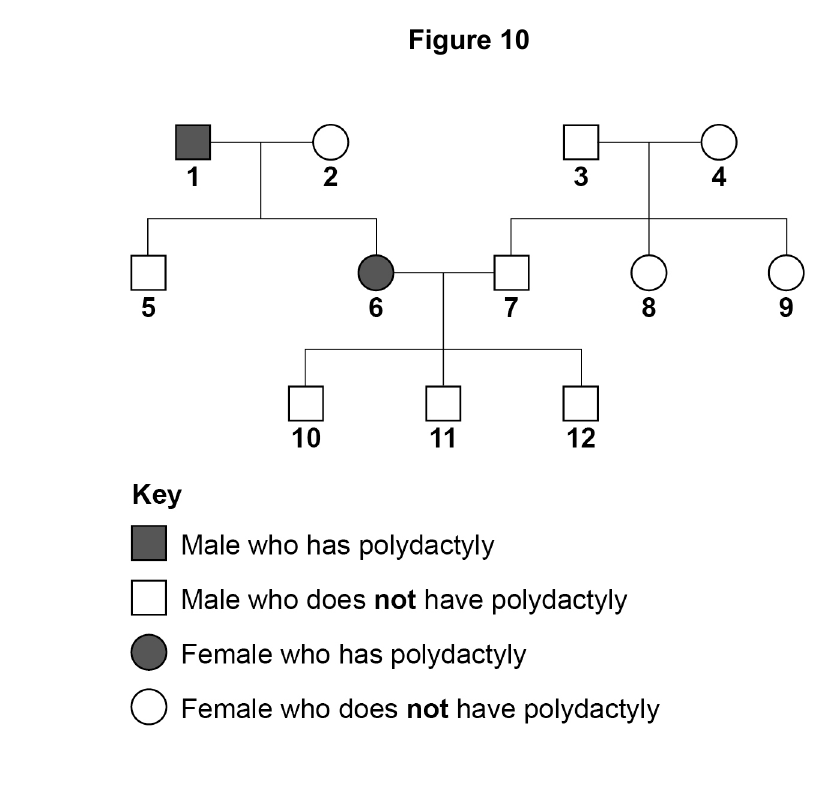
Polydactyly is an inherited disorder caused by a dominant allele. Figure 10 shows the inheritance of polydactyly in one family.
- D
- allele for having polydactyly
- d
- allele for not having polydactyly
Persons 6 and 7 are expecting a fourth child. A doctor states that the probability of having a child with polydactyly is 0.5. Explain how the doctor determined this probability.
- draw a Punnett square diagram
- give the genotype of person 6 and the genotype of person 7
- identify all the offspring that will have polydactyly
Practice unavailable
This question can be viewed, but its original response format is not available for practice yet.
Write your answer first. You can study the marking guidance whenever you need it.
Study the marking See what earns credit and compare it with a full-mark answer.
Marking points
- 1 Gives person 6 as Dd and/or her gametes as D and d.
- 2 Gives person 7 as dd and/or his gametes as d and d.
- 3 Derives Dd, Dd, dd and dd in a correct Punnett square.
- 4 Identifies the two Dd outcomes as affected and links two of four outcomes to probability 0.5.
Full-mark answer
Person 6 is Dd and produces D or d gametes. Person 7 is dd and produces d gametes only. A Punnett square gives Dd, Dd, dd and dd. The two Dd offspring have polydactyly, so 2 out of 4 outcomes are affected: 2/4 = 0.5.
Why this answer loses marks
The previous unaffected children mean the next child is likely to be unaffected.
Previous births do not change the cross; derive both parents’ genotypes, their gametes and all Punnett outcomes.