 Question Constellation Sign up for free
 AQA · GCSE · Chemistry · Higher
Water treatment and purification processes
Water collected from rivers is used in the home for drinking and flushing toilets. Water used in the home must be potable. Potable water is safe to drink. Waste water produced after use in the home is called sewage. Figure 3 shows how water is collected from rivers and returned to rivers after use.
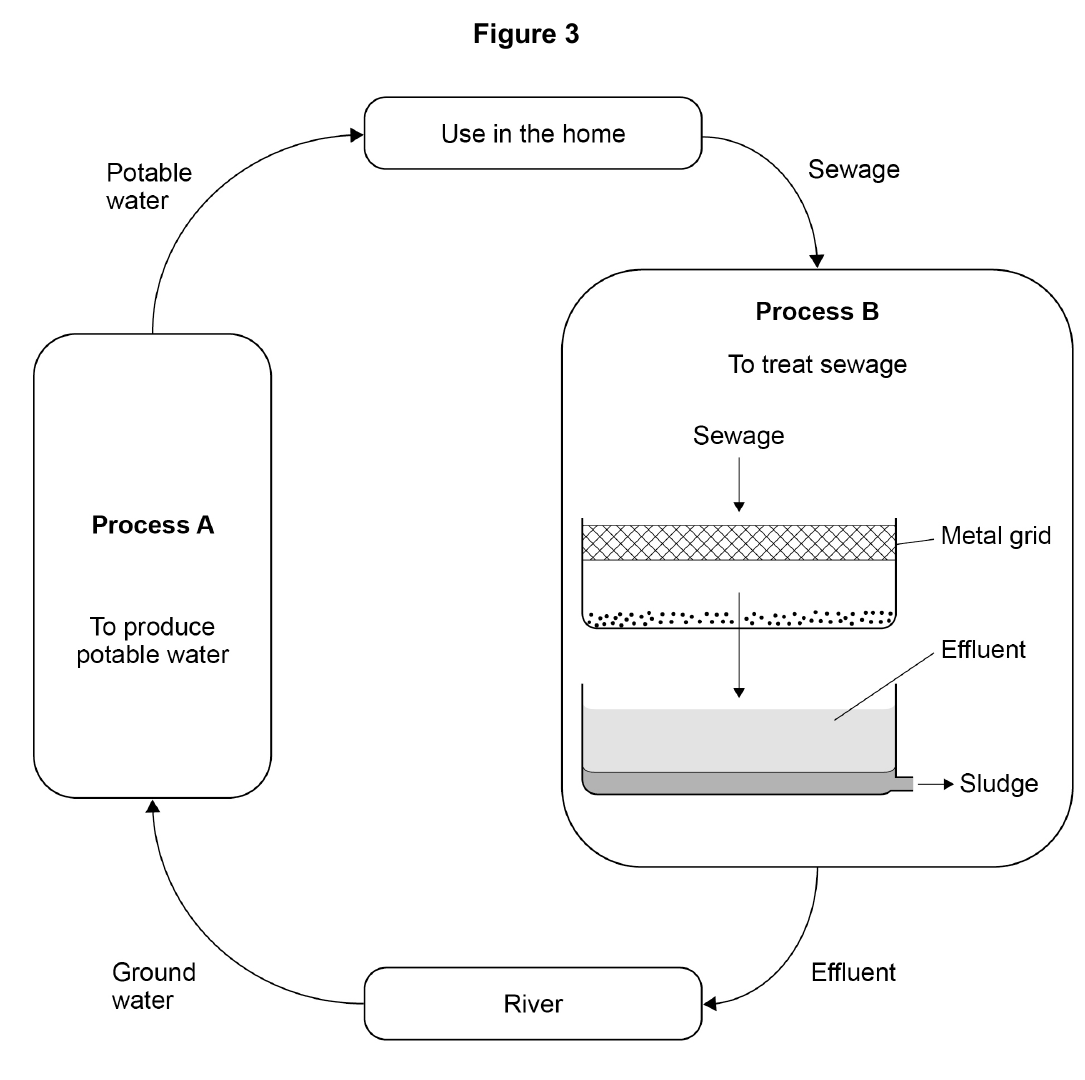
Explain what happens to water in Process A and in Process B in Figure 3. Do not refer to use of water in the home.
Write your answer first. You can study the marking guidance whenever you need it.
Study the marking See what earns credit and compare it with a full-mark answer.
Marking points
- 1 Gives relevant, detailed treatment steps for Process A (potable-water production), such as filtration with its purpose and sterilisation with its purpose.
- 2 Gives relevant, detailed treatment steps for Process B (waste-water treatment), such as screening, sedimentation and biological treatment with their purposes or outputs.
- 3 Logically links the treatment steps and effects to form a clear account covering both processes for the highest level.
Full-mark answer
In Process A, river or ground water is passed through filter beds to remove solid particles. It is then sterilised, for example using chlorine, ozone or ultraviolet light, to destroy microorganisms and make the water potable. In Process B, sewage is screened through a metal grid to remove large solids and grit. Sedimentation separates the sewage into sludge and effluent. The sludge is treated by anaerobic digestion, while the effluent receives aerobic biological treatment before the treated effluent is returned to the river.
Why this answer loses marks
River water is filtered until clean, and sewage is separated before returning to the river.
This is too vague: it omits sterilisation, does not name sludge and effluent, and gives no biological treatment for either output.