 Question Constellation Sign up for free
 AQA · GCSE · Chemistry · Higher
Chromatography dye separation distances
A student investigated an orange dye (A) using paper chromatography. Figure 4 shows the results of Experiment 1 and Experiment 2 using orange dye A.
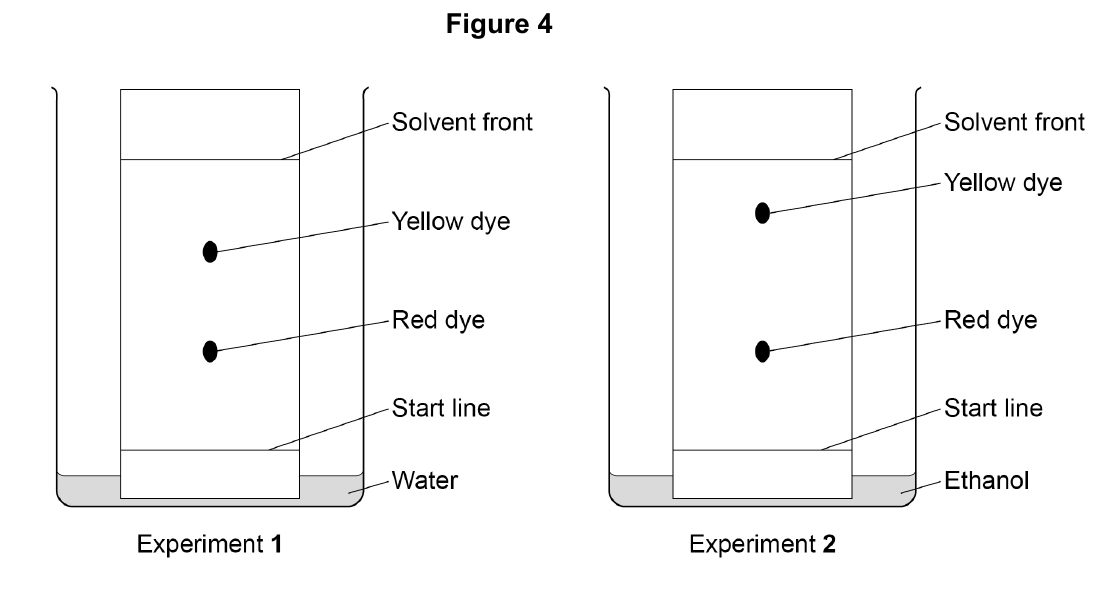
Explain why the yellow dye and red dye travel different distances in Experiment 1. Refer to forces of attraction between the dyes and the chromatography paper in your answer.
Write your answer first. You can study the marking guidance whenever you need it.
Study the marking See what earns credit and compare it with a full-mark answer.
Marking points
- 1 Identifies that the yellow dye travels farther than the red dye (or gives the valid converse comparison).
- 2 Links the greater distance to the yellow dye having weaker attraction to the chromatography paper (or gives the valid converse).
Full-mark answer
The yellow dye travels farther than the red dye because it is less strongly attracted to the chromatography paper. The red dye is more strongly attracted to the paper, so it travels a shorter distance.
Why this answer loses marks
The yellow dye moves farther because it is a lighter colour.
Colour shade does not explain travel distance; the answer must compare attraction to the chromatography paper.