 Question Constellation Sign up for free
 AQA · GCSE · Chemistry · Higher
Solvent effects on chromatography
Figure 4 shows the results of Experiment 1 and Experiment 2 using orange dye A.
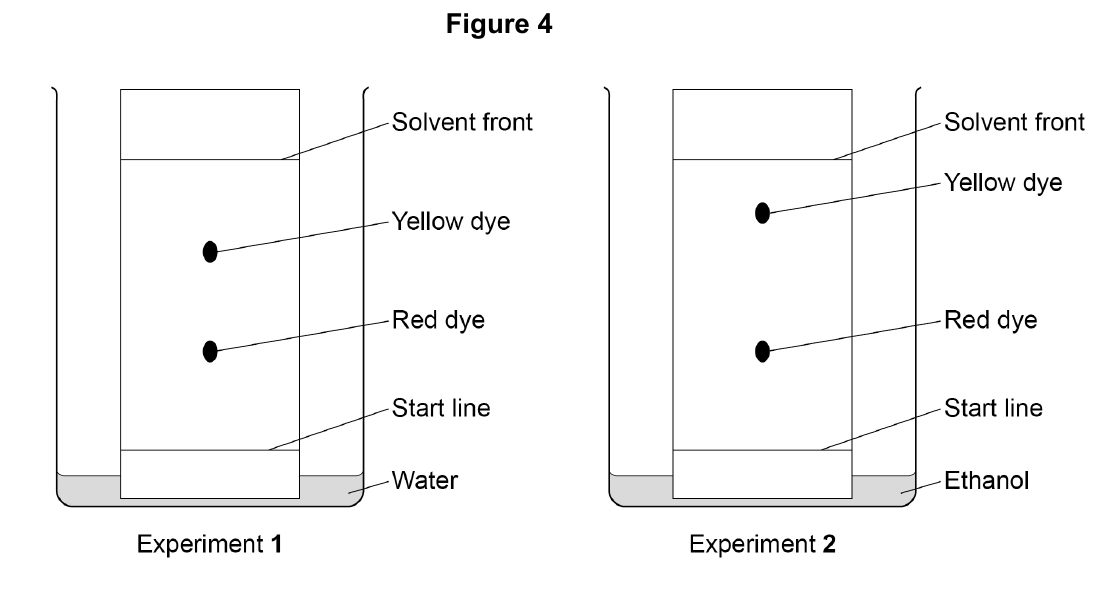
The student used the same type of chromatography paper in Experiment 1 and in Experiment 2. Explain why the yellow dye is in different positions in Experiment 1 and in Experiment 2. Use Figure 4.
Write your answer first. You can study the marking guidance whenever you need it.
Study the marking See what earns credit and compare it with a full-mark answer.
Marking points
- 1 Uses Figure 4 to state that the yellow dye travels farther in Experiment 2 (or less far in Experiment 1).
- 2 Recognises that different solvents/mobile phases are used: water and ethanol.
- 3 Links the position difference to greater solubility/attraction in ethanol than water, or the valid converse.
Full-mark answer
The yellow dye travels farther in Experiment 2. The solvents are different: Experiment 1 uses water and Experiment 2 uses ethanol. The yellow dye is more soluble in, or more strongly attracted to, ethanol than water, so it is carried farther by ethanol.
Why this answer loses marks
The yellow dye is farther up because a different type of paper was used.
The paper type stayed the same; the explanation must use the different solvents and the dye’s relative solubility.