 Question Constellation Sign up for free
 AQA · GCSE · Chemistry · Higher
Hydrogen amount calculation from graph
Figure 11 shows the volumes of hydrogen collected in the 50 cm³ measuring cylinder after 40 seconds and after 100 seconds.
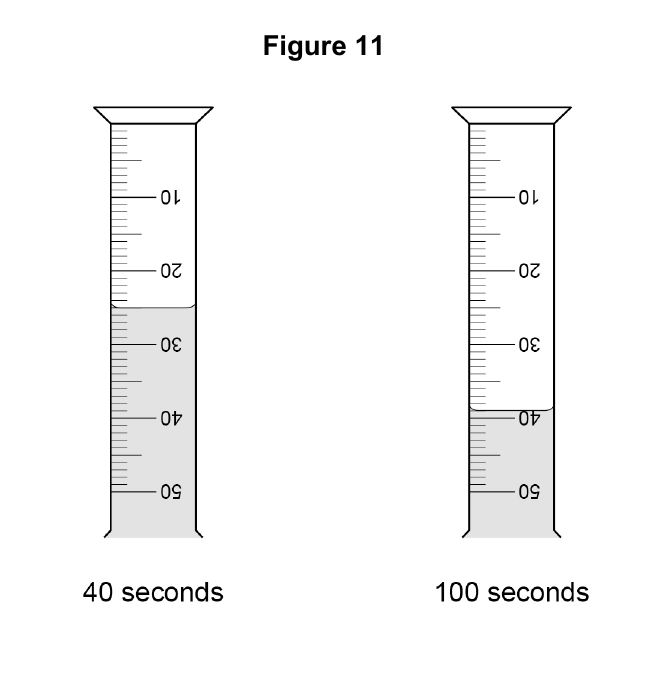
Determine the number of moles of hydrogen collected between 40 seconds and 100 seconds. The volume of one mole of any gas at room temperature and pressure is 24 dm³.
Write your answer first. You can study the marking guidance whenever you need it.
Study the marking See what earns credit and compare it with a full-mark answer.
Marking points
- 1 Reads both measuring cylinders and obtains a 14 cm³ volume difference.
- 2 Uses consistent gas-volume units by converting 14 cm³ to 0.014 dm³ or 24 dm³ to 24 000 cm³.
- 3 Divides the volume difference by the molar gas volume, or uses an equivalent separate-moles route.
- 4 Gives 5.8 × 10⁻⁴ mol or an accepted equivalent/rounding.
Full-mark answer
Volume collected between 40 s and 100 s = 39 − 25 = 14 cm³ = 0.014 dm³. Moles of hydrogen = 0.014 ÷ 24 = 5.833… × 10⁻⁴ mol = 5.8 × 10⁻⁴ mol (2 s.f.).
Why this answer loses marks
The student uses the later cylinder reading as the volume collected during the interval.
The starting reading must be subtracted first; otherwise the calculation includes gas collected before the interval.