 Question Constellation Sign up for free
 AQA · GCSE · Physics · Higher
Wire Resistance Investigation Method
A student investigated how the length of a wire affects the resistance of the wire at constant temperature.
Figure 3 shows the circuit used.
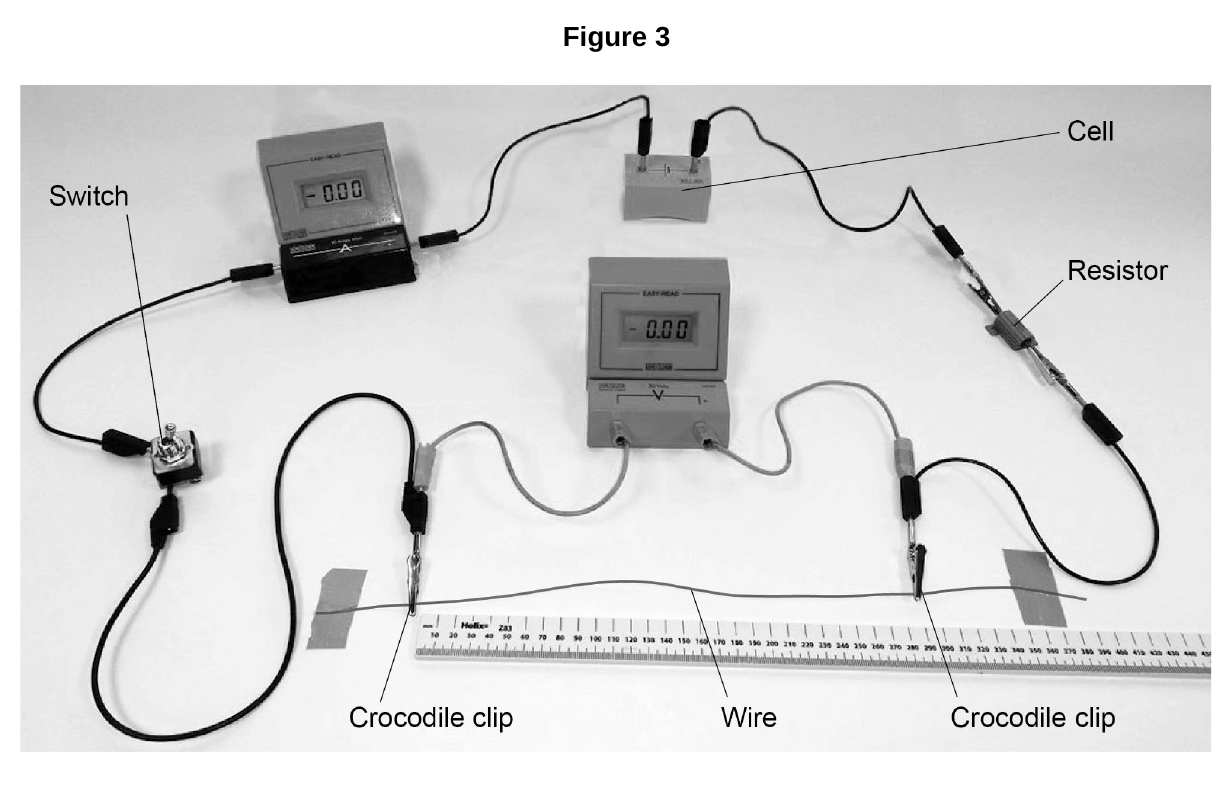
Describe a method the student could have used to collect the data needed to plot the graph.
Practice unavailable
This question can be viewed, but its original response format is not available for practice yet.
Write your answer first. You can study the marking guidance whenever you need it.
Study the marking See what earns credit and compare it with a full-mark answer.
Marking points
- 1 Explains how the measured wire length is obtained and varied.
- 2 Measures both current and potential difference for each length.
- 3 Calculates resistance for each length using R = V/I.
- 4 Includes a valid reliability procedure such as repeat readings and means.
- 5 Controls heating so the wire remains at constant temperature and presents a logical sequence capable of producing valid data.
Full-mark answer
Set the crocodile clips a measured distance apart on the wire and use the ruler to measure the wire length between them. Close the switch briefly and record the current from the ammeter and the potential difference from the voltmeter. Calculate the resistance using R = V/I. Move a crocodile clip to several different measured lengths and repeat. Take repeated current and potential-difference readings at each length and calculate mean resistance values, excluding any anomalous readings. Keep the current low and disconnect the circuit between readings so the wire does not heat up.
Why this answer loses marks
Change the wire length and record the ammeter reading.
This misses the voltmeter reading, the resistance calculation, repeat readings and the control needed to stop heating changing resistance.