 Question Constellation Sign up for free
 AQA · GCSE · Physics · Higher
Thermistor Potential Divider
Figure 8 shows part of a circuit used to monitor the temperature inside the vending machine.
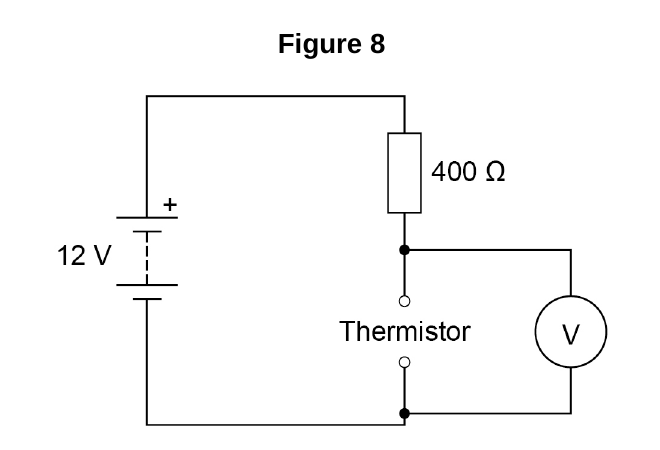
Figure 9 shows how the resistance of the thermistor varies with temperature.
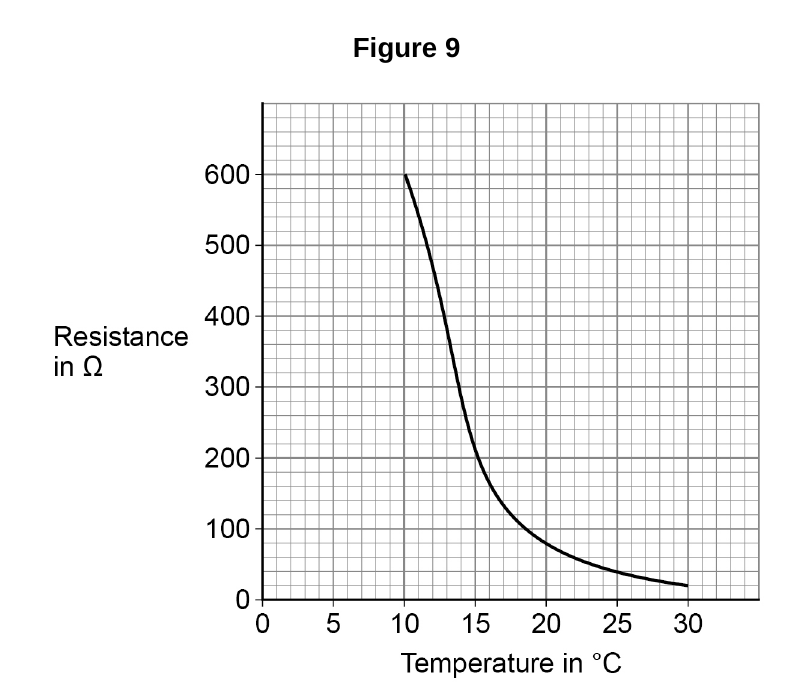
The cooling system inside the vending machine turns on when the temperature of the thermistor is above 20 °C.
Determine the potential difference across the thermistor when the temperature is 20 °C.
Use the Physics Equations Sheet.
Write your answer first. You can study the marking guidance whenever you need it.
Study the marking See what earns credit and compare it with a full-mark answer.
Marking points
- 1 Reads the thermistor resistance at 20 °C from Figure 9 within the allowed 70–90 Ω range and combines it with 400 Ω.
- 2 Uses the 12 V supply and total series resistance to find current, or uses an equivalent potential-divider ratio.
- 3 Uses the thermistor resistance to find its potential difference.
- 4 Obtains 2.0 V within the allowed 1.8–2.2 V range.
Full-mark answer
From Figure 9, the thermistor resistance at 20 °C is about 80 Ω. The total series resistance is 400 + 80 = 480 Ω, so the current is I = 12/480 = 0.025 A. The potential difference across the thermistor is V = IR = 0.025 × 80 = 2.0 V.
Why this answer loses marks
I used the supply potential difference as the thermistor potential difference.
Series components share the supply. Read the thermistor resistance, combine the resistances, then use current or a divider ratio to find its share.