 Question Constellation Sign up for free
 AQA · GCSE · Physics · Higher
Braking Distance from Force and Mass
Another train travels at a speed of 60 m/s. A constant braking force of 270 000 N causes the train to decelerate and stop. mass of train = 240 000 kg. Use the Physics Equations Sheet.
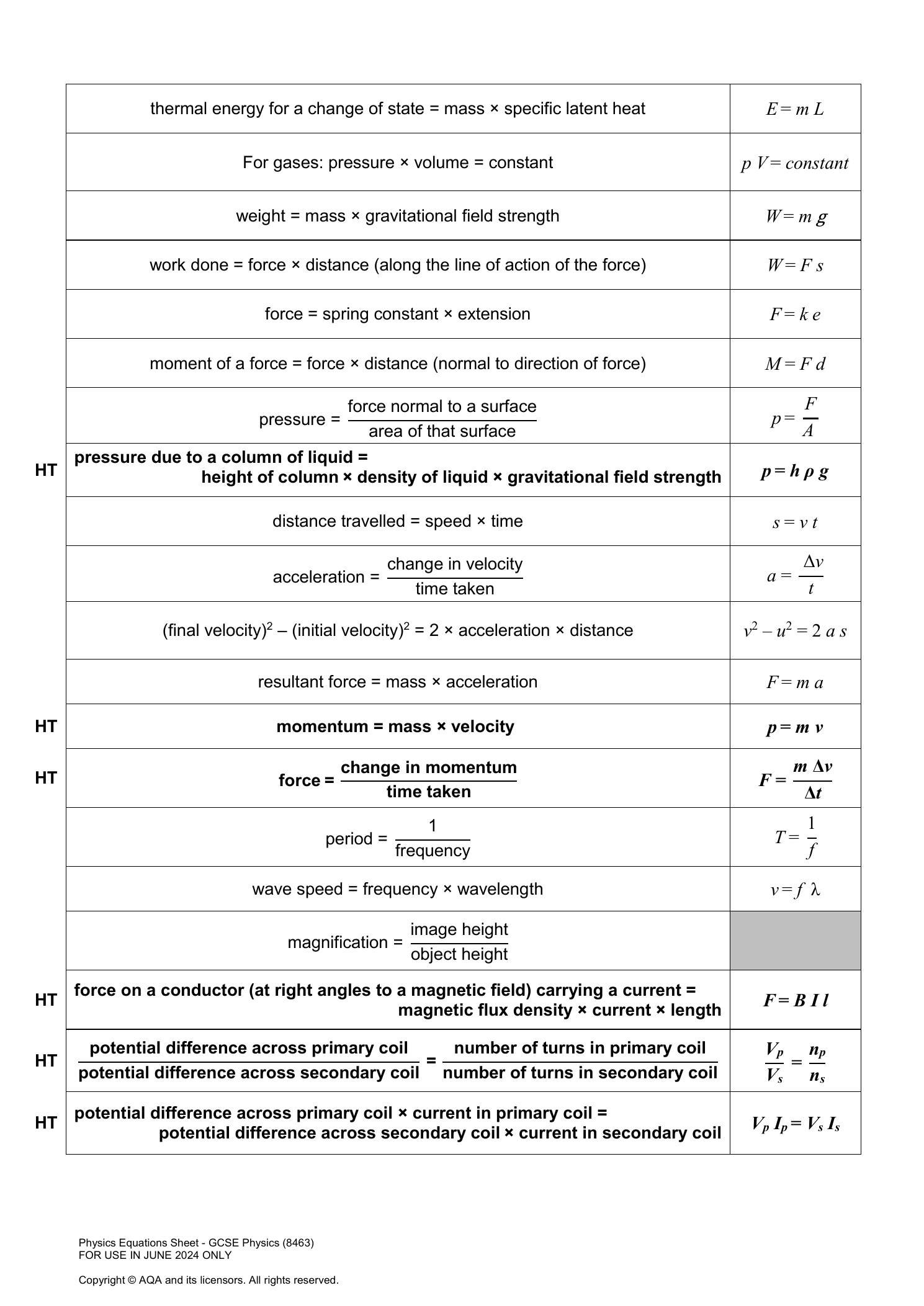
Calculate the distance travelled while the braking force is applied.
Write your answer first. You can study the marking guidance whenever you need it.
Study the marking See what earns credit and compare it with a full-mark answer.
Marking points
- 1 Completes one valid six-stage official route: force plus constant-acceleration equations, energy plus work done, or momentum plus stopping time and mean speed.
- 2 On the force route, obtains the deceleration magnitude 1.125 m/s² from F = ma.
- 3 On the force route, uses v² − u² = 2as and obtains 1600 m.
- 4 Alternatively follows the complete energy or momentum route with its stated equation dependency.
Full-mark answer
Using F = ma, a = −270 000 ÷ 240 000 = −1.125 m/s². Then v² = u² + 2as gives 0 = 60² + 2(−1.125)s, so s = 3600 ÷ 2.25 = 1600 m.
Why this answer loses marks
Uses the braking force as though it were the deceleration.
Force must first be divided by mass to obtain deceleration before a constant-acceleration equation can give distance.