 Question Constellation Sign up for free
 AQA · GCSE · Physics · Higher
Moving-Coil Microphone Induction
Figure 14 shows a sound wave incident on the diaphragm of a moving-coil microphone. The inside of the microphone includes a small coil of wire and a magnet.
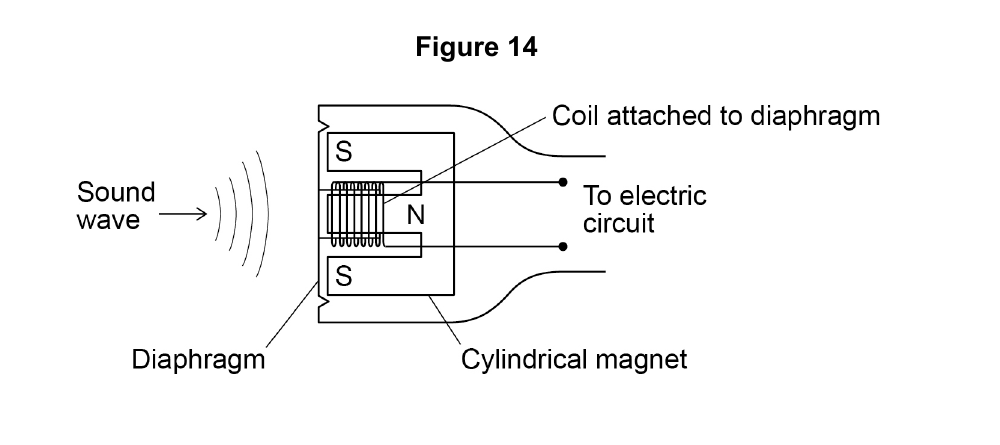
Explain why the sound waves have an effect on the electric circuit.
Write your answer first. You can study the marking guidance whenever you need it.
Study the marking See what earns credit and compare it with a full-mark answer.
Marking points
- 1 Links pressure variations in the sound wave to vibration of the diaphragm.
- 2 Links the vibrating diaphragm to vibration of the attached coil or wire.
- 3 Explains that the coil's repeated change of direction induces an alternating current in the circuit.
Full-mark answer
Pressure variations in the sound wave make the diaphragm vibrate. The attached coil therefore vibrates in the magnetic field and repeatedly changes its direction of motion, inducing an alternating current in the connected circuit.
Why this answer loses marks
The diaphragm and coil move up and down.
The official scheme rejects that direction claim; identify pressure-driven vibration, transfer it to the coil, and explain repeated direction change producing alternating current.