 Question Constellation Sign up for free
 AQA · GCSE · Biology · Higher
Finding the isotonic concentration
A student investigated the concentration of salt in solution Z using osmosis. Table 1 shows the results.
| Concentration of salt solution in mol/dm³ | Mass of tube at start in grams | Mass of tube after 2 hours in grams | Change in mass in grams | Percentage (%) change in mass |
|---|---|---|---|---|
| 0.0 | 15.54 | 16.50 | 0.96 | X |
| 0.2 | 15.16 | 15.78 | 0.62 | 4.1 |
| 0.4 | 15.00 | 15.35 | 0.35 | 2.3 |
| 0.6 | 15.29 | 15.37 | 0.08 | 0.5 |
| 0.8 | 14.95 | 14.75 | −0.20 | −1.3 |
| 1.0 | 14.77 | 14.40 | −0.37 | −2.5 |
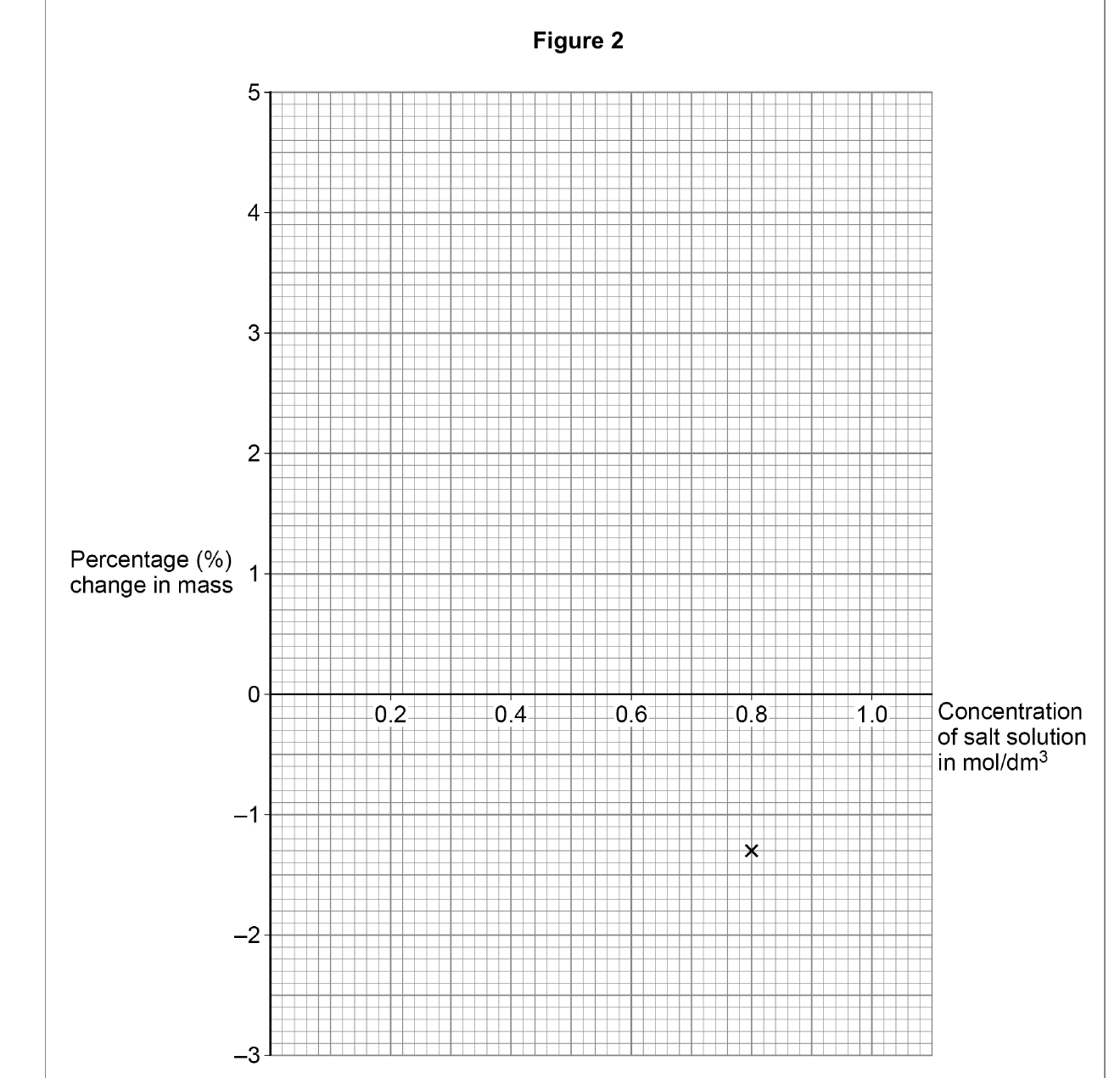
Determine the concentration of salt in solution Z. Use Figure 2.
Write your answer first. You can study the marking guidance whenever you need it.
Study the marking See what earns credit and compare it with a full-mark answer.
Marking points
- 1 Reads the zero-percentage-change intercept from the line of best fit; without a drawn line, gives a value from 0.64 to 0.66 mol/dm³.
Full-mark answer
The line of best fit crosses 0% change at about 0.65 mol/dm³, so the concentration of solution Z is approximately 0.65 mol/dm³ (accept 0.64 to 0.66 mol/dm³ if no line is shown).
Why this answer loses marks
Choose the nearest measured concentration from the table.
The unknown comes from where the fitted trend crosses zero mass change, followed by a reading from the horizontal axis.