 Question Constellation Sign up for free
 AQA · GCSE · Biology · Higher
Cell size and magnification
Figure 4 shows a special slide used to determine the size of a cell viewed using a microscope.
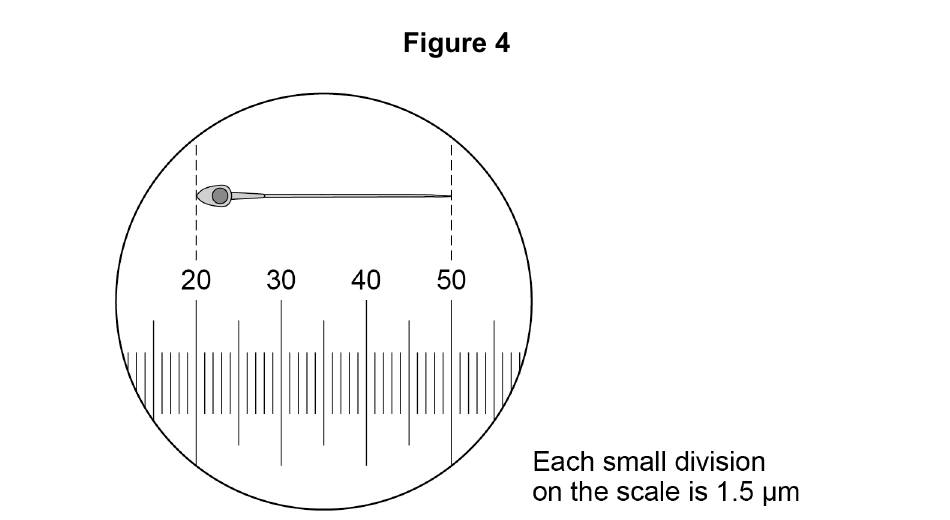
Move the two guides to the dashed endpoints of the cell image. The result uses the original paper scale.
Calculate the magnification of the cell shown in Figure 4.
Write your answer first. You can study the marking guidance whenever you need it.
Study the marking See what earns credit and compare it with a full-mark answer.
Marking points
- 1 Measures the printed cell image within the accepted 35-37 mm range.
- 2 Converts the measured image size to the same unit as the real cell size.
- 3 Uses 30 small scale divisions at 1.5 µm each to obtain a real size of 45 µm.
- 4 Applies magnification = image size ÷ real size with consistent units.
- 5 Gives 800 with no unit.
Full-mark answer
The printed cell image measures about 36 mm = 36 000 µm. The cell spans 30 small divisions, so its real size is 30 × 1.5 µm = 45 µm. Magnification = 36 000 ÷ 45 = 800, so the answer is ×800.
Why this answer loses marks
Treat the number of scale divisions as the real size and give the magnification a length unit.
Each division has a scale value, so real size must use both pieces of evidence; magnification itself has no length unit.