 Question Constellation Sign up for free
 AQA · GCSE · Biology · Higher
The cell cycle in sequence
Smoking increases the risk of lung cancer. Figure 5 shows a lung cell dividing.
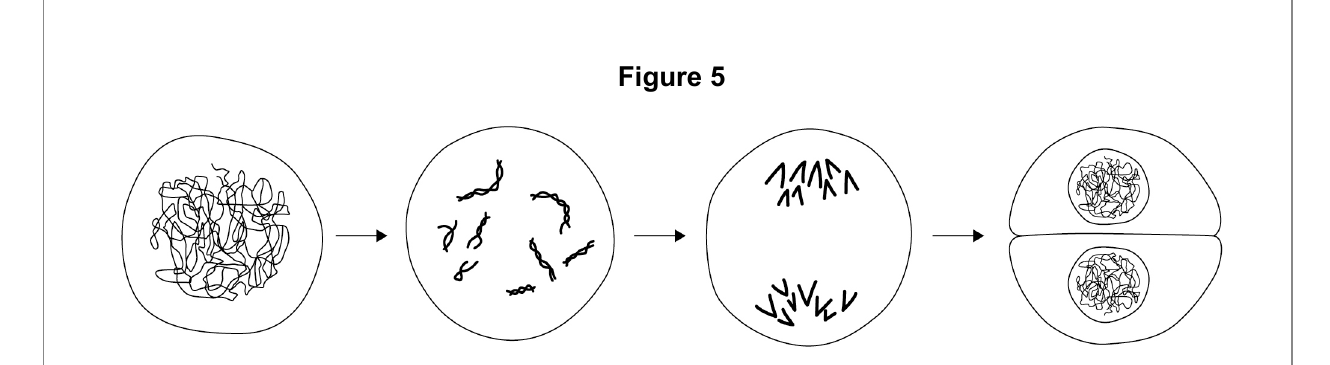
Describe the process of the cell cycle shown in Figure 5.
Write your answer first. You can study the marking guidance whenever you need it.
Study the marking See what earns credit and compare it with a full-mark answer.
Marking points
- 1 Describes DNA/chromosome replication first.
- 2 Describes one set of chromosomes moving to each end of the cell.
- 3 Describes nuclear division / formation of two nuclei.
- 4 Describes cytoplasmic or membrane division producing two genetically identical cells.
Full-mark answer
First the DNA replicates so that two copies of each chromosome are present. One set of chromosomes is then pulled to each end of the cell. The nucleus divides to form two nuclei, and finally the cytoplasm and cell membrane divide to produce two genetically identical daughter cells.
Why this answer loses marks
DNA reproduces and then the cell splits into two cells.
Use the accepted replication wording and include chromosome separation, nuclear division, and the genetically identical outcome in order.