 Question Constellation Sign up for free
 AQA · GCSE · Biology · Higher
Homeostasis and optimal reaction time
Scientists investigated whether blood glucose concentration affects reaction time. The reaction times of ten people with Type 1 diabetes were measured. Figure 6 shows the results.
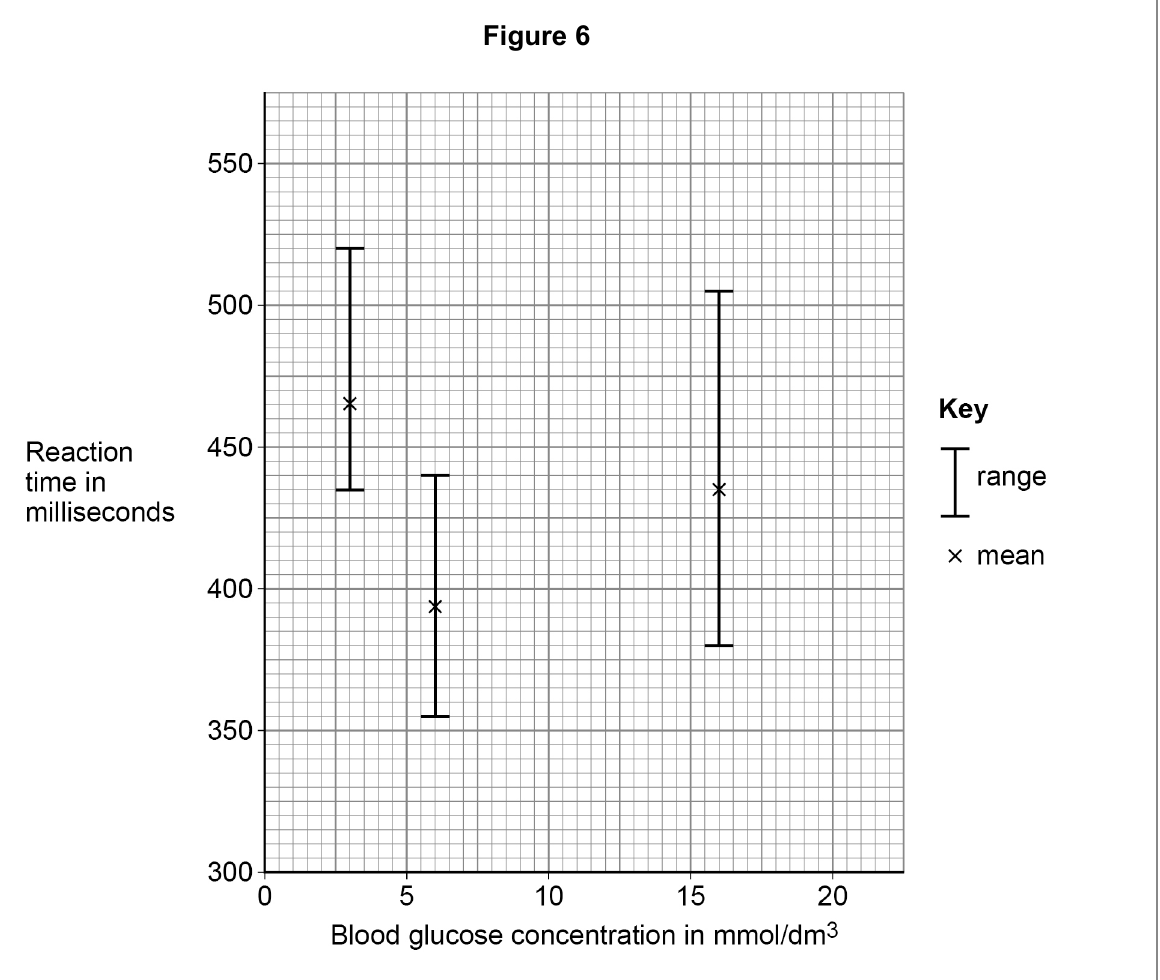
People who do not have diabetes usually have a blood glucose concentration in the range of 4.0 mmol/dm³ to 7.8 mmol/dm³. Describe how the results in Figure 6 show the importance of homeostasis.
Write your answer first. You can study the marking guidance whenever you need it.
Study the marking See what earns credit and compare it with a full-mark answer.
Marking points
- 1 Uses Figure 6 to link the normal 4.0–7.8 mmol/dm³ range with the lowest reaction times, or notes that high and low concentrations raise mean reaction time.
- 2 Links the result to maintaining a narrow range by homeostasis or to the survival advantage of lower reaction time.
Full-mark answer
The lowest mean reaction time is at 6 mmol/dm³, inside the normal 4.0–7.8 mmol/dm³ range, while both 3 and 16 mmol/dm³ give higher means. Homeostasis keeps blood glucose in a narrow range where reaction time is lower, which can provide a survival advantage.
Why this answer loses marks
Homeostasis keeps everything constant.
Homeostasis maintains a narrow range, not an unchanging value, and the answer must use the reaction-time pattern to show why that control matters.