 Question Constellation Sign up for free
 AQA · GCSE · Chemistry · Higher
Comparing sodium chloride and oxygen
Table 2 shows diagrams which represent the structures of two substances.
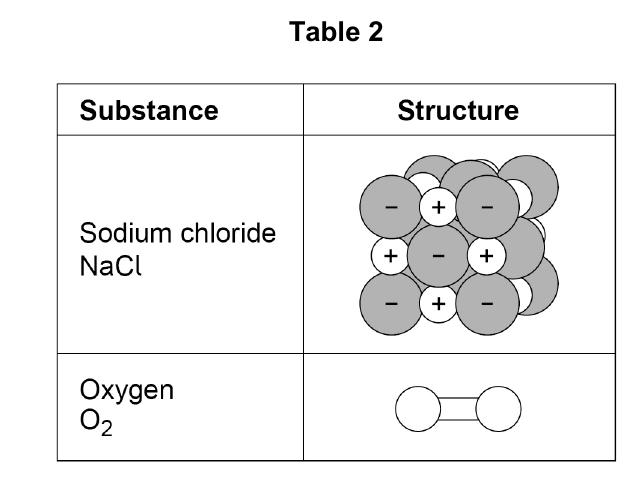
Compare the structure and bonding of sodium chloride and oxygen.
Write your answer first. You can study the marking guidance whenever you need it.
Study the marking See what earns credit and compare it with a full-mark answer.
Marking points
- 1 Makes scientifically accurate, explicit comparisons between the two substances rather than listing isolated facts.
- 2 For the highest level, compares the structure or bonding of both substances and conveys magnitude, such as giant ionic structure versus small oxygen molecules or strong bonds versus weak intermolecular forces.
Full-mark answer
Sodium chloride is a giant ionic lattice made of oppositely charged sodium and chloride ions. Electrons are transferred from sodium atoms to chlorine atoms, and there are strong electrostatic attractions throughout the giant structure. Oxygen is an element made of small O₂ molecules. In each molecule the two oxygen atoms share electrons in a double covalent bond, but only weak forces act between separate oxygen molecules. Thus both contain strong bonds and particles with full outer shells, but sodium chloride has a giant ionic structure whereas oxygen has small covalent molecules.
Why this answer loses marks
Sodium chloride is ionic and oxygen is covalent.
This names bond types but does not develop the particle structures, electron transfer or sharing, or intermolecular-force contrast needed for a higher-level comparison.