 Question Constellation Sign up for free
 AQA · GCSE · Chemistry · Higher
Fractional distillation of crude oil
Crude oil is a mixture of hydrocarbons.
Figure 1 represents industrial equipment used to separate crude oil into fractions.
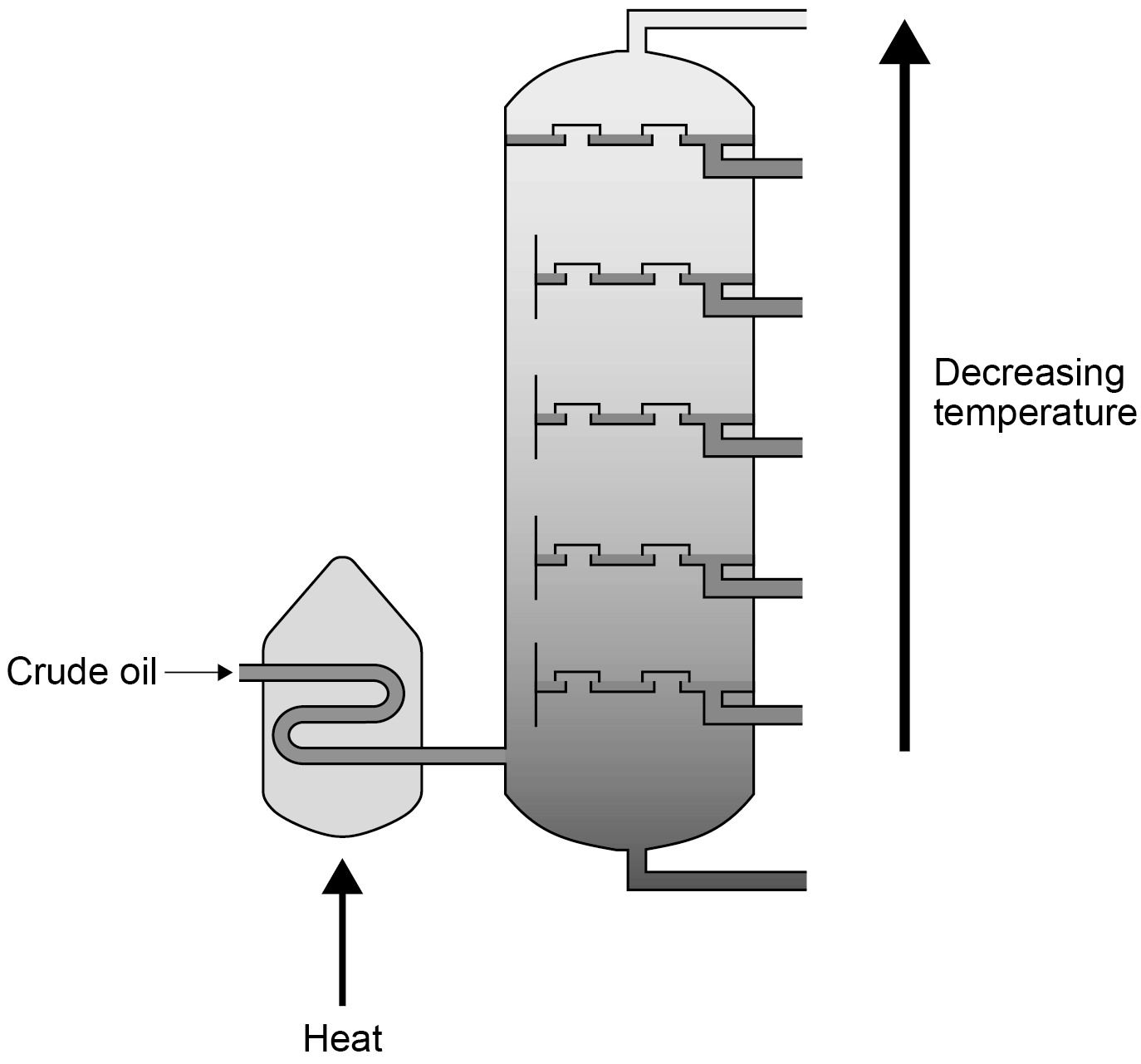
Explain how crude oil is separated into fractions. Use Figure 1.
Write your answer first. You can study the marking guidance whenever you need it.
Study the marking See what earns credit and compare it with a full-mark answer.
Marking points
- 1 States that the crude oil is heated.
- 2 States that hydrocarbons vaporise.
- 3 Describes the temperature gradient: the column gets cooler upwards.
- 4 Explains that fractions condense at different heights or temperatures, at their boiling points.
Full-mark answer
The crude oil is heated so that hydrocarbons vaporise. The vapours enter the fractionating column, which is hot at the bottom and cooler towards the top. Different hydrocarbons have different boiling points, so they condense at different temperatures and therefore at different heights in the column.
Why this answer loses marks
The crude oil is heated and the fractions rise to different heights.
This misses vaporisation, the column temperature gradient, and condensation at different boiling points.