 Question Constellation Sign up for free
 AQA · GCSE · Chemistry · Higher
Designing a valid rate experiment
A student investigated the effect of changing the particle size of calcium carbonate on the rate of reaction with hydrochloric acid.
Figure 3 shows the apparatus.
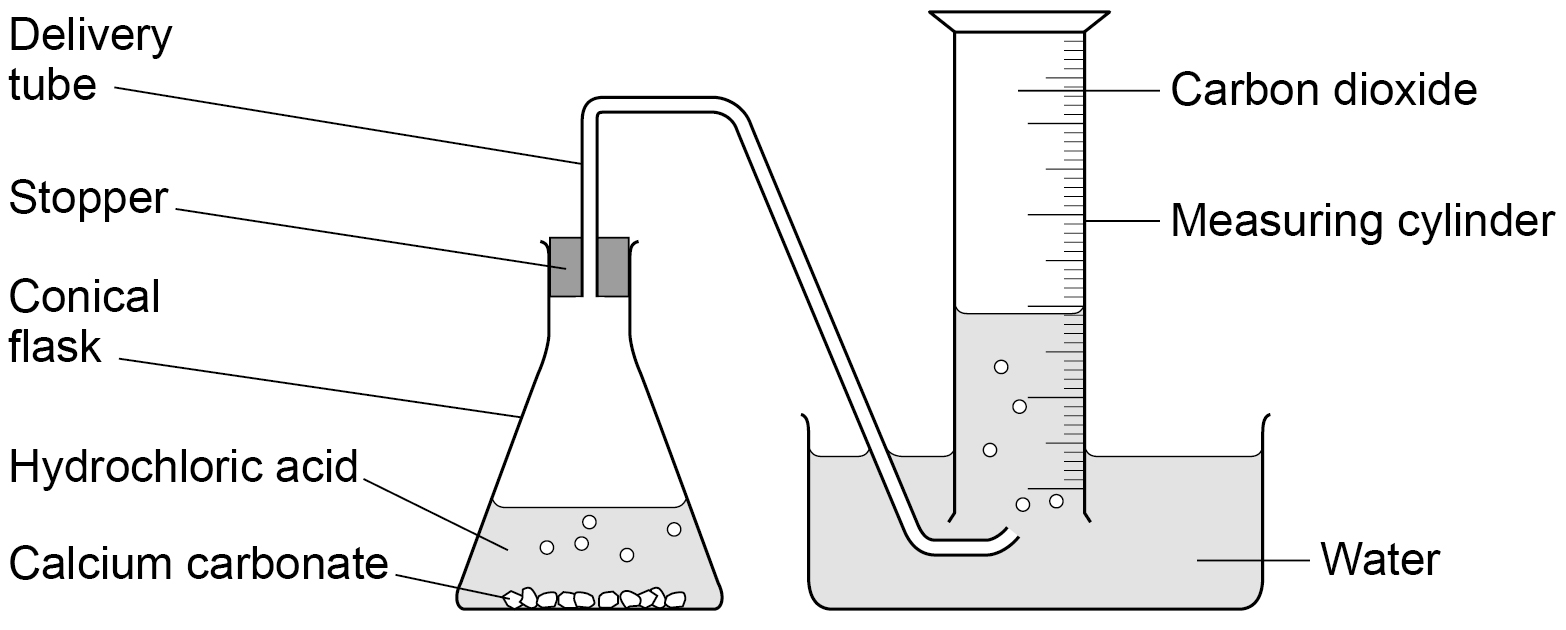
Describe a method the student could use to produce valid results.
Write your answer first. You can study the marking guidance whenever you need it.
Study the marking See what earns credit and compare it with a full-mark answer.
Marking points
- 1 For full credit, presents a valid, logically sequenced method with the key measurement, collection, variable-control and repeat steps.
- 2 Measures a fixed volume of hydrochloric acid with a measuring cylinder.
- 3 Measures a fixed mass of calcium carbonate with a balance.
- 4 Assembles and starts the reaction and timer in a workable sequence.
- 5 Measures rate using gas volume over time or time for a fixed gas volume.
- 6 Changes calcium-carbonate particle size while controlling the listed variables and repeating trials.
Full-mark answer
Use a measuring cylinder to measure a fixed volume of hydrochloric acid and a balance to measure a fixed mass of calcium carbonate. Put one particle size of calcium carbonate in the conical flask, add the acid, immediately fit the stopper and delivery tube, and start a timer. Record the volume of carbon dioxide in the measuring cylinder at regular time intervals (or measure the time taken to collect a fixed volume). Repeat with different particle sizes. Keep the mass of calcium carbonate and the acid’s volume, concentration and temperature the same. Repeat each experiment and compare the results.
Why this answer loses marks
Use different sizes of calcium carbonate and record the gas produced.
This changes the intended variable and measures gas, but it does not fix reactant amounts and acid conditions or repeat the trials.