 Question Constellation Sign up for free
 AQA · GCSE · Chemistry · Higher
Recognising equilibrium on reaction graphs
A scientist measured how the number of moles of sulfur dioxide, oxygen and sulfur trioxide varied with time during the reaction.
Figure 5 shows the results.
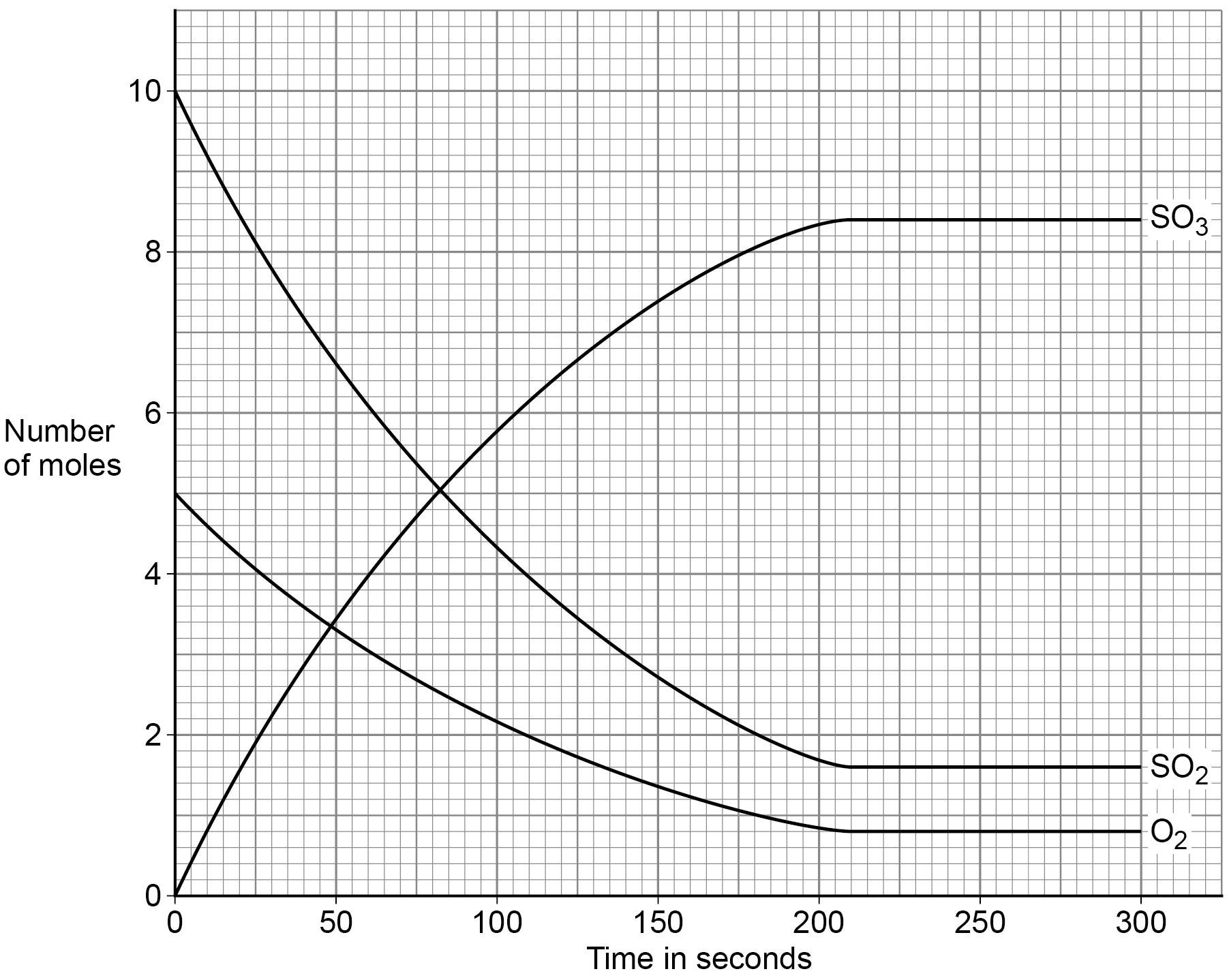
Determine the time taken for the reaction to reach equilibrium. Explain your answer. Use Figure 5.
Write your answer first. You can study the marking guidance whenever you need it.
Study the marking See what earns credit and compare it with a full-mark answer.
Marking points
- 1 Gives a time in the official accepted range 205–210 s.
- 2 Identifies that the curves become horizontal.
- 3 Explains that forward and reverse rates are equal or that all three amounts remain constant.
Full-mark answer
Time: about 210 s. Explanation: at this point all three curves become horizontal, so the numbers of moles remain constant because the forward and reverse reactions are occurring at equal rates.
Why this answer loses marks
Equilibrium is reached when the three curves cross.
The amounts do not need to meet; find where all curves become horizontal, then read the corresponding time.