 Question Constellation Sign up for free
 AQA · GCSE · Combined Science · Higher
LDR potential-divider meter readings
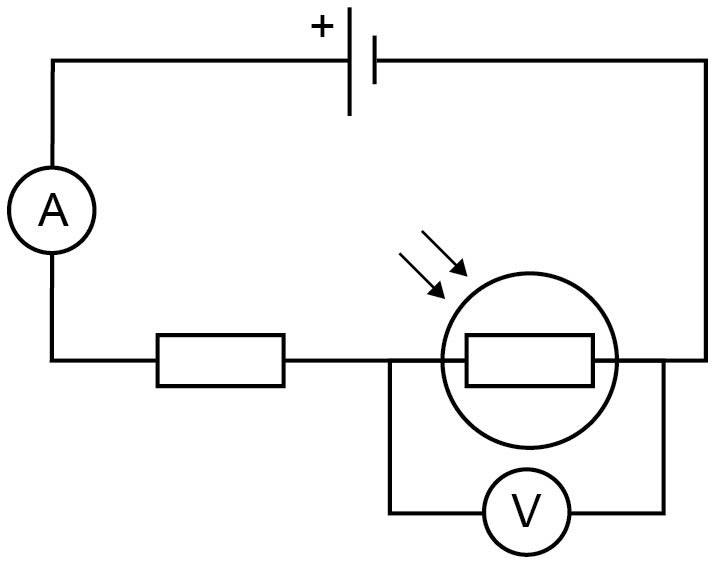
The student builds a different circuit.
Figure 11 shows the circuit.
Explain how the readings on both meters change when the environmental conditions change.
Write your answer first. You can study the marking guidance whenever you need it.
Study the marking See what earns credit and compare it with a full-mark answer.
Marking points
- 1 State that changing light intensity changes the resistance of the LDR.
- 2 For increased light intensity, state that the resistance of the LDR decreases.
- 3 Explain that the total circuit resistance decreases while the supply potential difference remains unchanged.
- 4 State that the ammeter reading increases because the circuit current increases.
- 5 Explain that the potential difference is shared between the fixed resistor and the LDR in series.
- 6 State that the potential difference across the fixed resistor increases and the potential difference across the LDR decreases.
- 7 State that the voltmeter reading across the LDR decreases.
Full-mark answer
When the light intensity increases, the resistance of the LDR decreases. This decreases the total resistance of the series circuit, while the supply potential difference stays the same, so the current increases and the ammeter reading increases. The potential difference is shared between the fixed resistor and the LDR; as the LDR has a smaller resistance it gets a smaller share of the potential difference, so the voltmeter reading across the LDR decreases.
Why this answer loses marks
More light makes the LDR resistance decrease, so both the ammeter and voltmeter readings increase.
The ammeter reading increases, but the voltmeter is across the LDR; its share of the potential difference decreases when its resistance decreases.