 Question Constellation Sign up for free
 AQA · GCSE · Physics · Higher
Scattering Evidence for the Nuclear Model
The alpha particle scattering experiment led to the plum pudding model of the atom being replaced by the nuclear model. Figure 2 shows the results predicted by the plum pudding model and the actual results from the alpha particle scattering experiment.
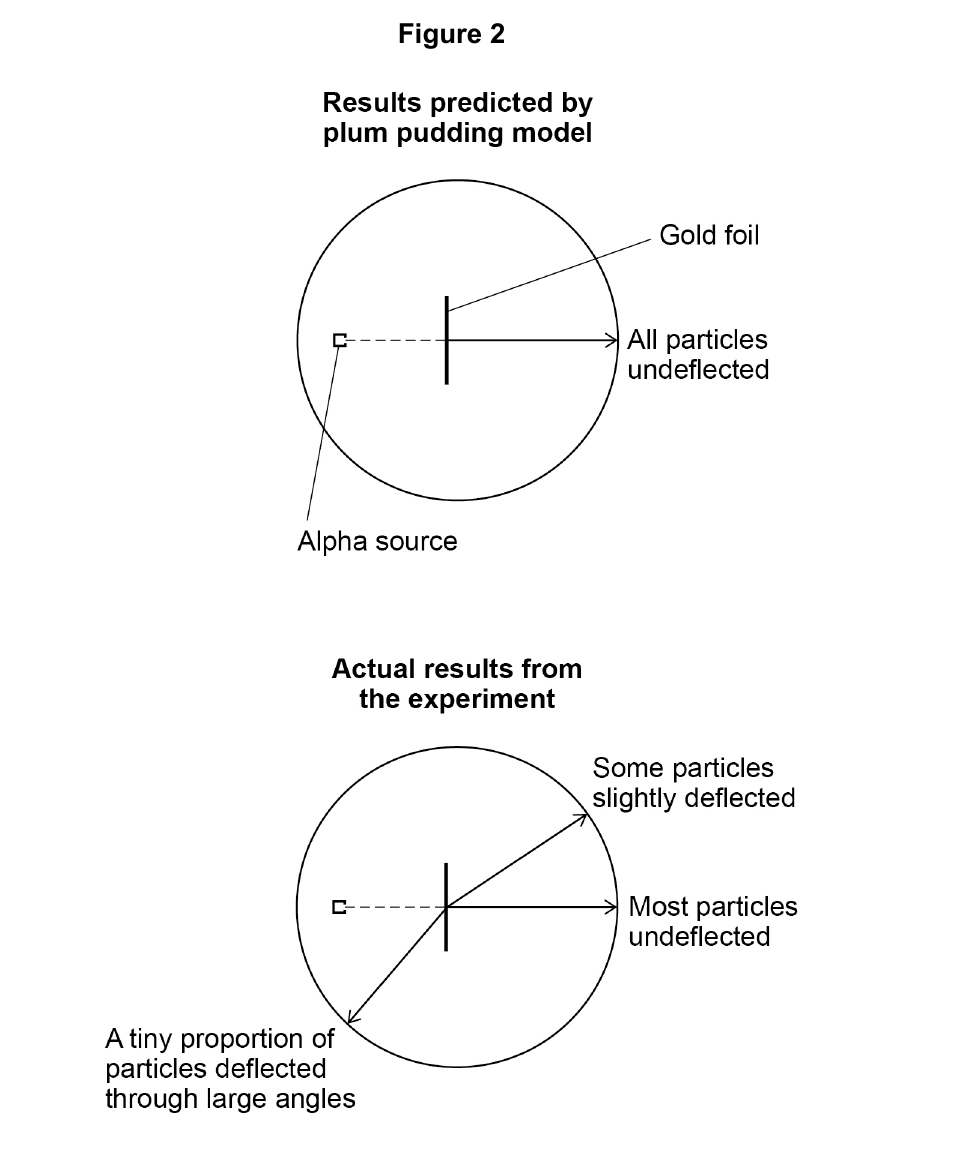
Describe how the actual results led to the plum pudding model of the atom being replaced by the nuclear model.
You should include details of the plum pudding model and the nuclear model of the atom.
Write your answer first. You can study the marking guidance whenever you need it.
Study the marking See what earns credit and compare it with a full-mark answer.
Marking points
- 1 Gives accurate details of the plum pudding model, including positive charge with embedded electrons.
- 2 Connects the unexpected actual scattering results to the need for a small charged nucleus and mostly empty space.
- 3 Gives accurate details of the nuclear model, with mass and charge concentrated in the nucleus and electrons orbiting in mostly empty space.
Full-mark answer
In the plum pudding model, the atom was a ball of positive charge with electrons embedded in it. That model predicted that all alpha particles would pass through undeflected, but the actual results showed that some were deflected and a tiny proportion were deflected through large angles. The large deflections showed that the atom’s positive charge and most of its mass must be concentrated in a very small, charged nucleus. Because most particles passed straight through, most of the atom must be empty space. In the nuclear model, electrons orbit the nucleus in this mostly empty space.
Why this answer loses marks
Lists the predicted and actual results without explaining what they show about the atom.
Link large deflections to a small charged nucleus and mostly undeflected particles to mostly empty space, while describing both models.