 Question Constellation Sign up for free
 AQA · GCSE · Combined Science · Higher
Predicting force direction on a wire
A teacher demonstrated the motor effect. Figure 5 shows the equipment used.
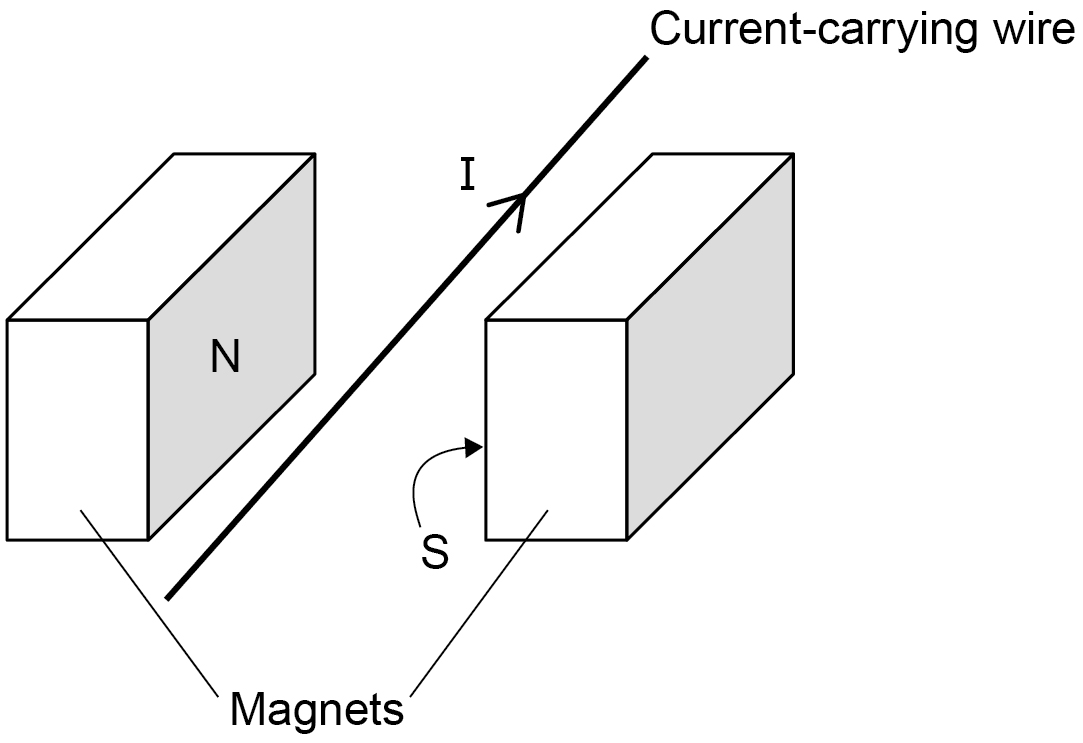
Explain how the direction of the force on the wire can be predicted.
Write your answer first. You can study the marking guidance whenever you need it.
Study the marking See what earns credit and compare it with a full-mark answer.
Marking points
- 1 Say to use Fleming’s left-hand rule.
- 2 Place the first finger in the direction of the magnetic field lines and the second finger in the direction of the current.
- 3 Use the thumb to show the direction of the force.
- 4 For the given arrangement, it is also creditworthy to identify the force as downwards.
Full-mark answer
Use Fleming’s left-hand rule. Point the first finger in the direction of the magnetic field and the second finger in the direction of the current; the thumb then points in the direction of the force. For this arrangement the force is downwards.
Why this answer loses marks
Use the right-hand rule.
The motor effect force direction for a current-carrying wire is predicted using Fleming’s left-hand rule.