 Question Constellation Sign up for free
 AQA · GCSE · Physics · Higher
Car's momentum before the brakes were applied calculation
The car was driven at a constant speed. The driver applied the maximum braking force, and the braking distance was measured.
The test was repeated at different speeds. Figure 8 shows the results.
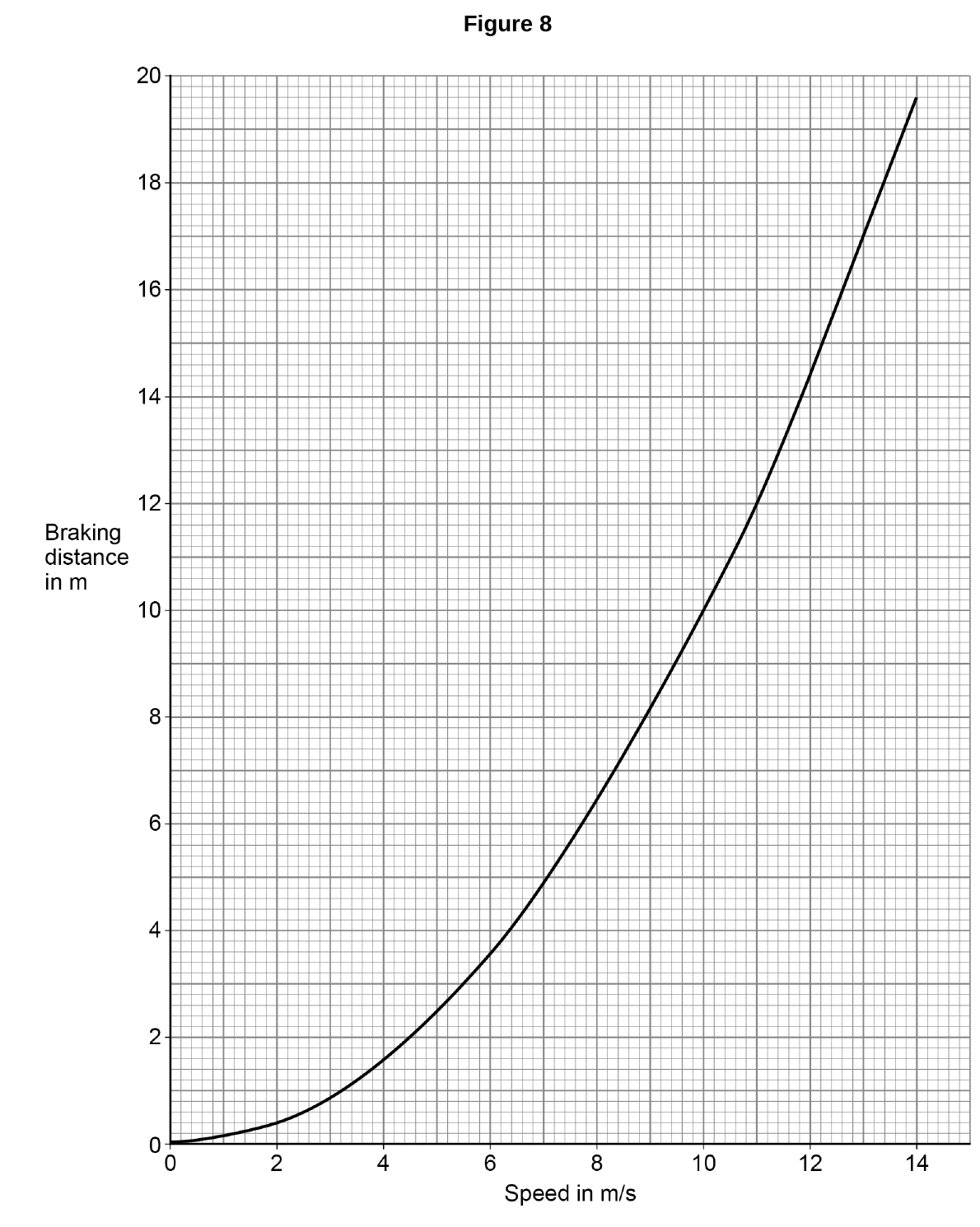
During one test the brakes were applied with a force of 6250 N.
The deceleration of the car was 5.0 m/s².
The braking distance of the car was 14.4 m.
Determine the momentum of the car before the brakes were applied.
Write your answer first. You can study the marking guidance whenever you need it.
Study the marking See what earns credit and compare it with a full-mark answer.
Marking points
- 1 Uses F = ma with the braking force and deceleration.
- 2 Rearranges to divide force by deceleration.
- 3 Finds the car's mass as 1250 kg.
- 4 Reads about 12 m/s (11.8–12.2 m/s accepted) from Figure 8 at 14.4 m.
- 5 Uses p = mv with the mass and graph-derived speed.
- 6 Obtains 15 000 kg m/s, with the official graph-read and error-carried-forward allowances.
Full-mark answer
From F = ma, m = F/a = 6250/5.0 = 1250 kg. Reading Figure 8 at a braking distance of 14.4 m gives a speed of about 12 m/s. Therefore p = mv = 1250 × 12 = 15 000 kg m/s.
Why this answer loses marks
I used the braking distance as the velocity in the momentum equation.
Distance and velocity are different quantities; the matching speed must be read from the graph first.