 Question Constellation Sign up for free
 AQA · GCSE · Combined Science · Higher
Forces and motion of the man
Figure 10 shows the horizontal forces acting on a man swimming in the sea.
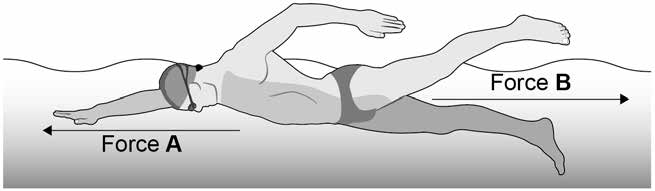
The man increases Force A.
Explain what happens to Force B and to the movement of the man.
Write your answer first. You can study the marking guidance whenever you need it.
Study the marking See what earns credit and compare it with a full-mark answer.
Marking points
- 1 State that the man accelerates when Force A is increased.
- 2 State that Force B increases.
- 3 Explain that Force B increases until it equals Force A, so the resultant force becomes zero again.
- 4 State that the man then moves at a higher constant velocity.
Full-mark answer
When Force A is increased, the man accelerates. As he moves faster, Force B increases until it is equal to Force A, so the resultant force becomes zero. The man then moves at a higher constant velocity.
Why this answer loses marks
Force B stays the same and the man keeps accelerating.
The mark scheme requires Force B to increase and eventually balance Force A, giving a higher constant velocity.