 Question Constellation Sign up for free
 OCR · GCSE · English Literature · Higher
Comparing Youth and Age in Poetry
Read the two poems below.
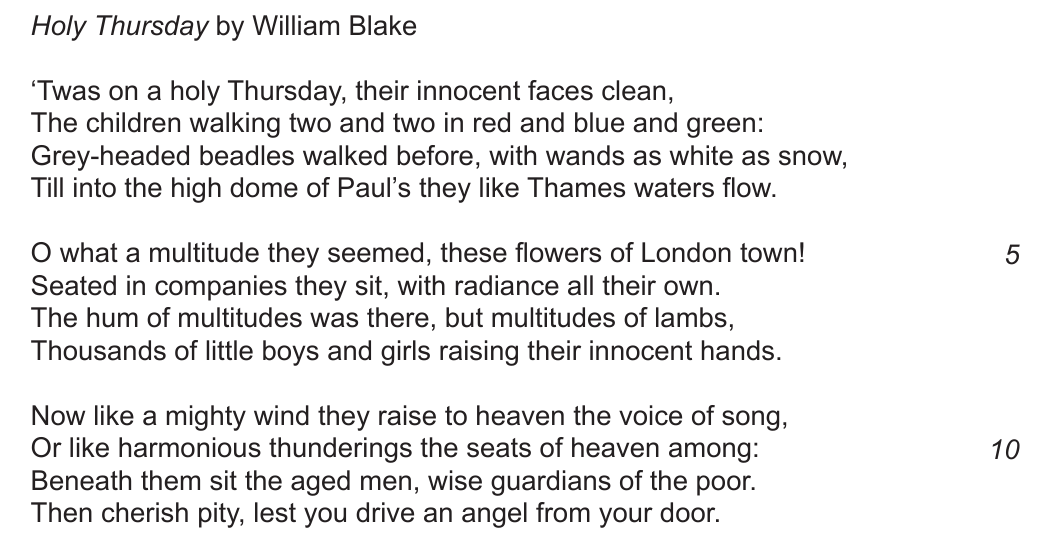
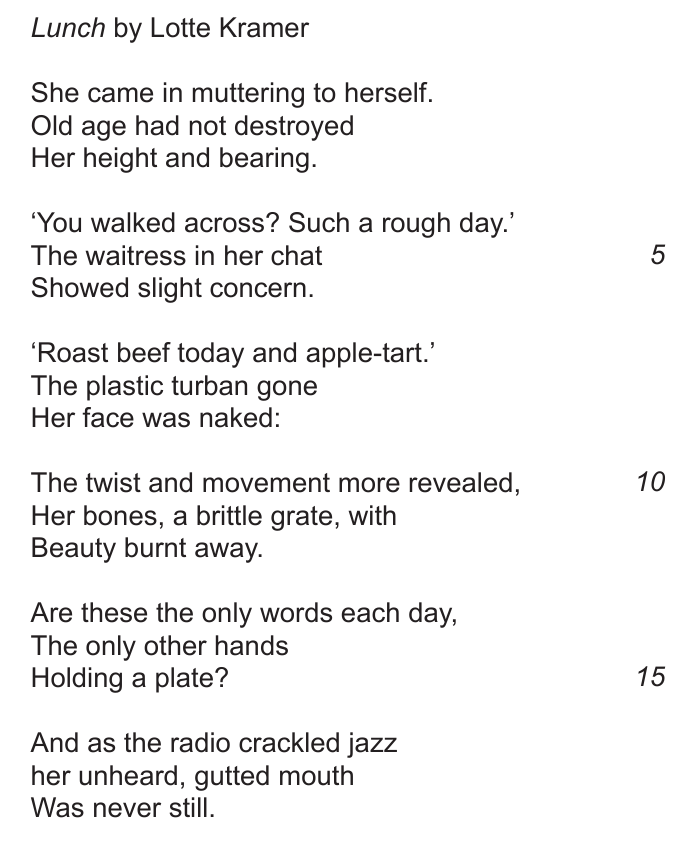
Compare how these two poems present contrasts between young people and old people.
You should consider:
- ideas and attitudes in each poem
- tone and atmosphere in each poem
- the effects of the language and structure used.
Write your answer first. You can study the marking guidance whenever you need it.
Study the marking See what earns credit and compare it with a full-mark answer.
Marking points
- 1 Develop an informed response to both poems with precise supporting references.
- 2 Analyse specific effects of language, form and structure rather than only listing techniques.
- 3 Sustain explicit comparison of how each poem judges the treatment or relationship of younger and older people.
- 4 A strong response may compare Blake’s public, rhythmic procession and admonition with Kramer’s narrowing triplets, stark imagery and unanswered question.
Full-mark answer
Both poems contrast generations in order to criticise a failure of care, but Blake centres the power and innocence of children while Kramer asks readers to notice an isolated old woman. In ‘Holy Thursday’, the children become ‘flowers’, ‘lambs’ and potentially an ‘angel’, images which stress innocence and spiritual value. Their voices rise like a ‘mighty wind’ and ‘harmonious thunderings’, giving the young collective power. Against this, the ‘grey-headed beadles’ and ‘wise guardians’ appear controlling and, in context, implicated in a social order that contains the poor. Blake’s final imperative, ‘cherish pity’, turns the contrast into a warning. In ‘Lunch’, the young waitress offers only conventional phrases and ‘slight concern’, while the old woman retains ‘height and bearing’ despite the harsh image of her bones as ‘a brittle grate’ with ‘Beauty burnt away’. The shortening triplets and enjambment narrow attention onto her isolation, and the question ‘Are these the only words each day’ challenges the lack of genuine contact. Blake’s children possess public radiance; Kramer’s old woman is unheard. Both poets expose a façade of care and direct sympathy towards those overlooked by the more powerful generation.
Why this answer loses marks
Ignore Blake’s final instruction and only describe the procession.
Use ‘Then cherish pity’ as Blake’s explicit judgement. It turns the scene into a warning about how the vulnerable young are treated.