 Question Constellation Sign up for free
 OCR · GCSE · English Literature · Higher
Fate in Romeo and Juliet
In this extract, the Chorus presents the conflict between the two houses and prepares the audience for the death-marked love of Romeo and Juliet.
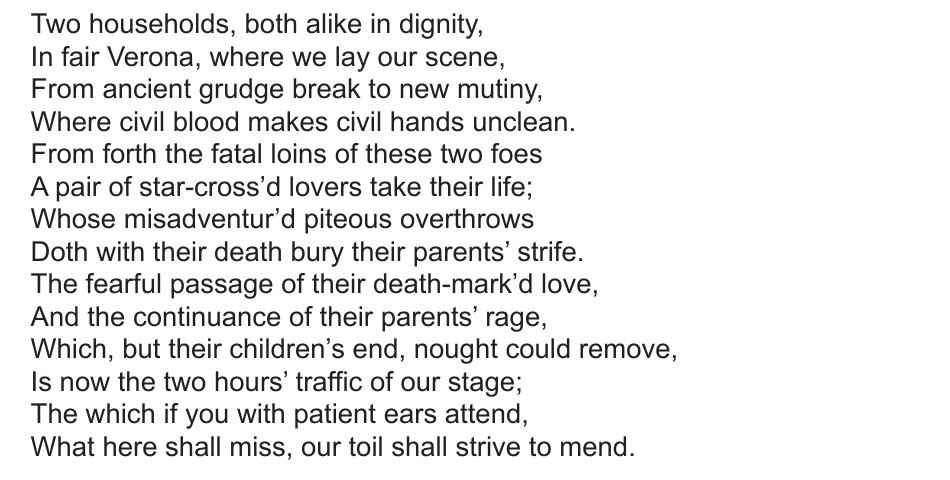
Explore the ways in which Shakespeare presents fate in this tragedy. Refer to this extract which is the Prologue and elsewhere in the play.
Write your answer first. You can study the marking guidance whenever you need it.
Study the marking See what earns credit and compare it with a full-mark answer.
Marking points
- 1 Use the complete Prologue extract and make developed links to relevant moments elsewhere in the play.
- 2 Develop a coherent interpretation of how fate, chance and human choice shape the tragedy, supported by references.
- 3 Analyse Shakespeare’s sonnet form, imagery, dramatic irony or structural choices for their effects.
- 4 Integrate only context that directly informs the presentation of fate and the feud.
- 5 Use accurate spelling and punctuation and controlled vocabulary and sentence structures.
Full-mark answer
Shakespeare presents fate as a pattern the audience can see before the lovers can, but he also leaves room to question how far human choices create the tragedy. The Prologue calls Romeo and Juliet ‘star-cross’d’ and their love ‘death-mark’d’, so their deaths seem written into the play from the beginning. Because the Chorus speaks directly to the audience in a sonnet, the audience becomes a critical observer of the ‘two hours’ traffic’ and recognises dramatic irony whenever the lovers hope to control their future. Images of ‘fatal loins’, ‘misadventur’d’ events and the opposition between ‘love’ and parental ‘rage’ connect fate with both chance and the inherited feud. Elsewhere, Romeo’s ‘O, I am fortune’s fool’ after killing Tybalt acknowledges that events have escaped his control, while ‘Then I defy you, stars’ shows him trying to resist the fate announced by the Prologue. Yet human decisions also matter: the feud creates the conditions for secrecy and violence, Friar Lawrence’s plan is risky, and the failed message turns apparent death into catastrophe. An audience familiar with astrology and predetermination could see outward signs of fate, but the Prince’s final judgement, ‘see what a scourge is laid upon your hate’, also assigns responsibility to the families. Fate therefore structures the tragedy, while Shakespeare uses the characters’ choices and social conflict to show how that fate is fulfilled.
Why this answer loses marks
The Chorus asks the audience to decide what will happen next because the ending is uncertain.
The Prologue has already announced the lovers’ deaths. The Chorus asks the audience to attend to how the known tragic outcome unfolds, creating dramatic irony.