 Question Constellation Sign up for free
 OCR · GCSE · English Literature · Higher
Shylock’s Family and Servant Relationships
In this extract, Launcelot has just told Shylock about his invitation to dine with his new master, Bassanio, and that there will be masked parties that night, as it is Carnival time.
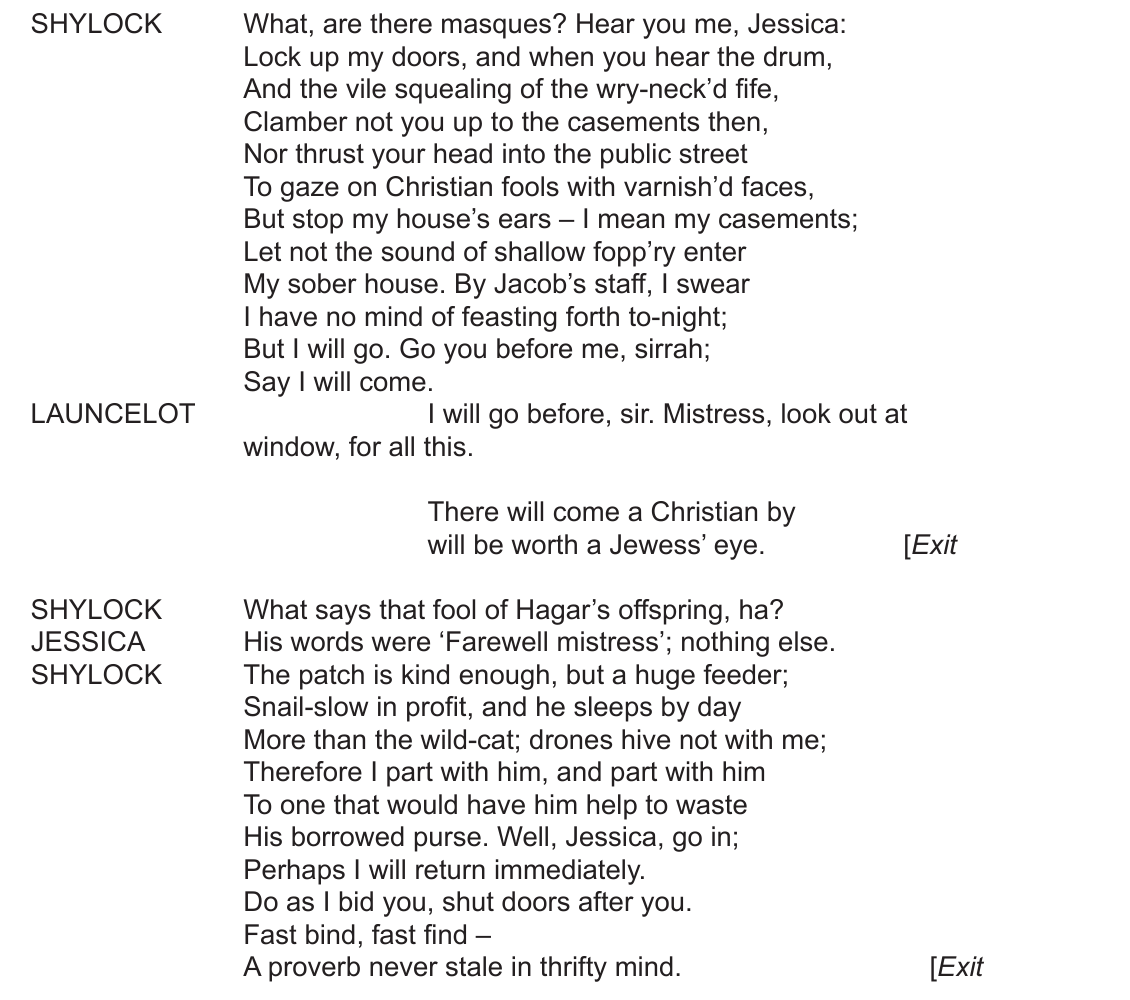
Explore the ways in which Shakespeare presents Shylock’s relationship with his family and servants. Refer to this extract from Act 2 Scene 5 and elsewhere in the play.
Write your answer first. You can study the marking guidance whenever you need it.
Study the marking See what earns credit and compare it with a full-mark answer.
Marking points
- 1 Use the complete extract and developed references elsewhere in the play, addressing both family and servant relationships.
- 2 Develop a nuanced interpretation of Shylock as controlling, protective, comic, victimised or a combination, with textual support.
- 3 Analyse language, dramatic contrasts and comic or tragic effects in the extract and wider play.
- 4 Integrate relevant context about Carnival, Jewish exclusion, patriarchy or stage-comedy conventions without using it as a detached add-on.
- 5 Use accurate spelling and punctuation and controlled vocabulary and sentence structures.
Full-mark answer
Shakespeare presents Shylock’s family and servant relationships as controlling and damaged by mistrust, but also shaped by exclusion. In the extract, Shylock orders Jessica to ‘Lock up my doors’ and not look at the ‘Christian fools with varnish’d faces’. The repeated imperatives make him a restrictive father, yet his fear is not imaginary: Launcelot is secretly encouraging Jessica to look for Lorenzo. Shylock’s ‘sober house’ opposes Carnival’s noisy freedom, and his Biblical ‘By Jacob’s staff’ asserts the heritage he wants to protect. With Launcelot, thrift becomes contempt. Calling him a ‘huge feeder’ and saying ‘drones hive not with me’ reduces the servant to an unproductive animal, although Shylock also recognises that Bassanio’s borrowed wealth may be wasted. Elsewhere, Jessica says ‘our house is hell’ and is ‘asham’d to be my father’s child’, supporting a view of Shylock as suffocating. However, the turquoise Leah gave him shows emotional attachment beyond money, and the Christians’ racism and the ghetto help explain why he distrusts them. Comedy may invite the audience to laugh at a Pantalone-like father robbed by clever young lovers, but the forced loss of daughter, servant, religion and property also creates tragic sympathy. Shakespeare therefore presents Shylock’s relationships as possessive and harsh while showing that betrayal and prejudice reinforce his isolation.
Why this answer loses marks
Attribute ‘O my ducats! O my daughter!’ directly and uncritically to Shylock, then argue that he says money first.
The line is reported by Salanio, so consider the reporter’s reliability and purpose. Do not omit ‘My daughter’ from the fuller report to manufacture a word-order claim.