 Question Constellation Sign up for free
 OCR · GCSE · English Literature · Higher
Horror in Macbeth
In this extract, Macduff expresses his reaction to the murder of King Duncan.
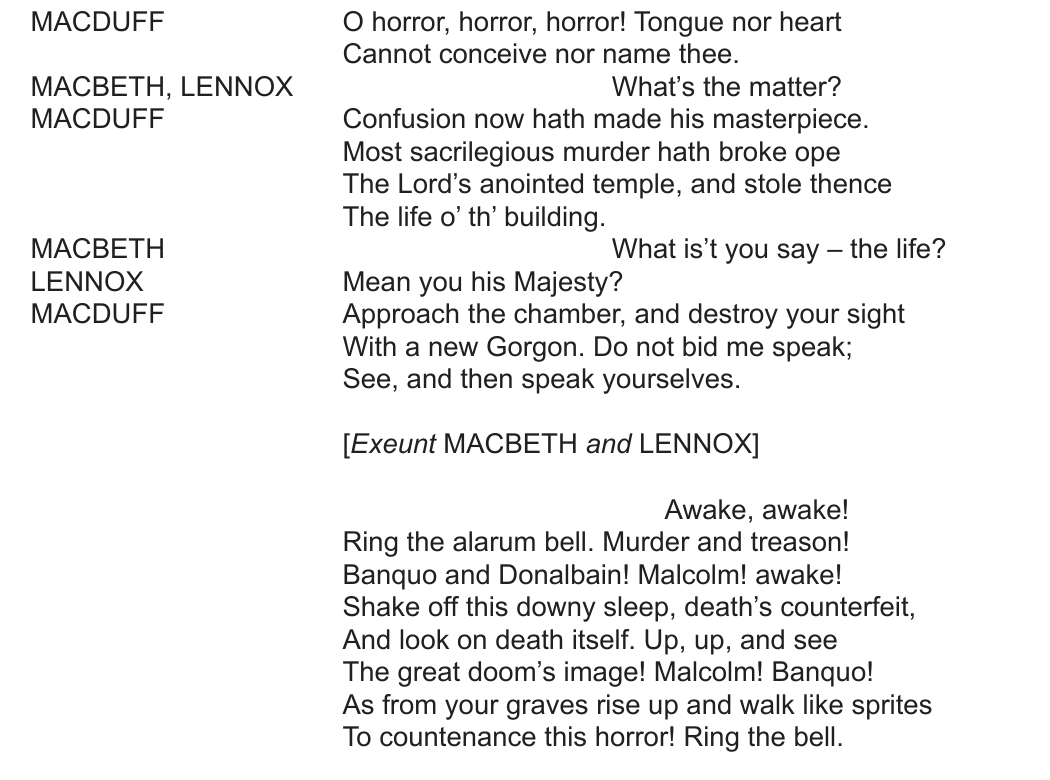
Explore how horror is presented in the play. Refer to this extract from Act 2 Scene 3 and elsewhere in the play.
Write your answer first. You can study the marking guidance whenever you need it.
Study the marking See what earns credit and compare it with a full-mark answer.
Marking points
- 1 Use the complete extract and developed references elsewhere in the play to explore more than one kind or effect of horror.
- 2 Develop a coherent critical argument rather than retelling a sequence of horrific events.
- 3 Analyse language, dramatic irony, stage action or structural choices for their effects on the audience.
- 4 Integrate relevant context about regicide, divine order, judgement or tragedy into textual analysis.
- 5 Use accurate spelling and punctuation and controlled vocabulary and sentence structures.
Full-mark answer
Shakespeare presents horror as physical, moral and psychological, often making what is imagined more disturbing than what is shown. In the extract, Duncan’s body remains offstage, so Macduff’s broken language forces the audience to picture it. The tricolon ‘O horror, horror, horror!’ and his claim that tongue and heart cannot ‘name’ the event make regicide seem beyond ordinary speech. Calling Duncan ‘The Lord’s anointed temple’ presents murder as sacrilege against God and the body politic, not merely violence inside a castle. The ‘new Gorgon’ and ‘great doom’s image’ combine classical and Christian images of sight, death and judgement. Dramatic irony also creates horror because Macbeth asks what has happened while the audience knows he is the murderer. Elsewhere, Banquo’s ghost makes guilt visible onstage, Lady Macduff’s murder turns political ambition against innocent family life, and Lady Macbeth’s sleepwalking shows horror internalised in a damaged mind. Images of blood and lost sleep connect these moments, while the witches invert natural and moral order. For an audience that associated kingship with divine authority, Duncan’s murder would threaten the whole social world. Shakespeare therefore uses reported violence, spectacle, language and psychological consequence to make horror both immediate and morally expansive.
Why this answer loses marks
‘The life o’ th’ building’ refers only to Duncan’s castle.
Read the full metaphor: Duncan is the life removed from the ‘anointed temple’, so the image presents regicide as destruction of a sacred human and political body.