 Question Constellation Sign up for free
 OCR · GCSE · English Literature · Higher
Surprises in Much Ado About Nothing
In this extract, their friends have revealed the love of Beatrice and Benedick.
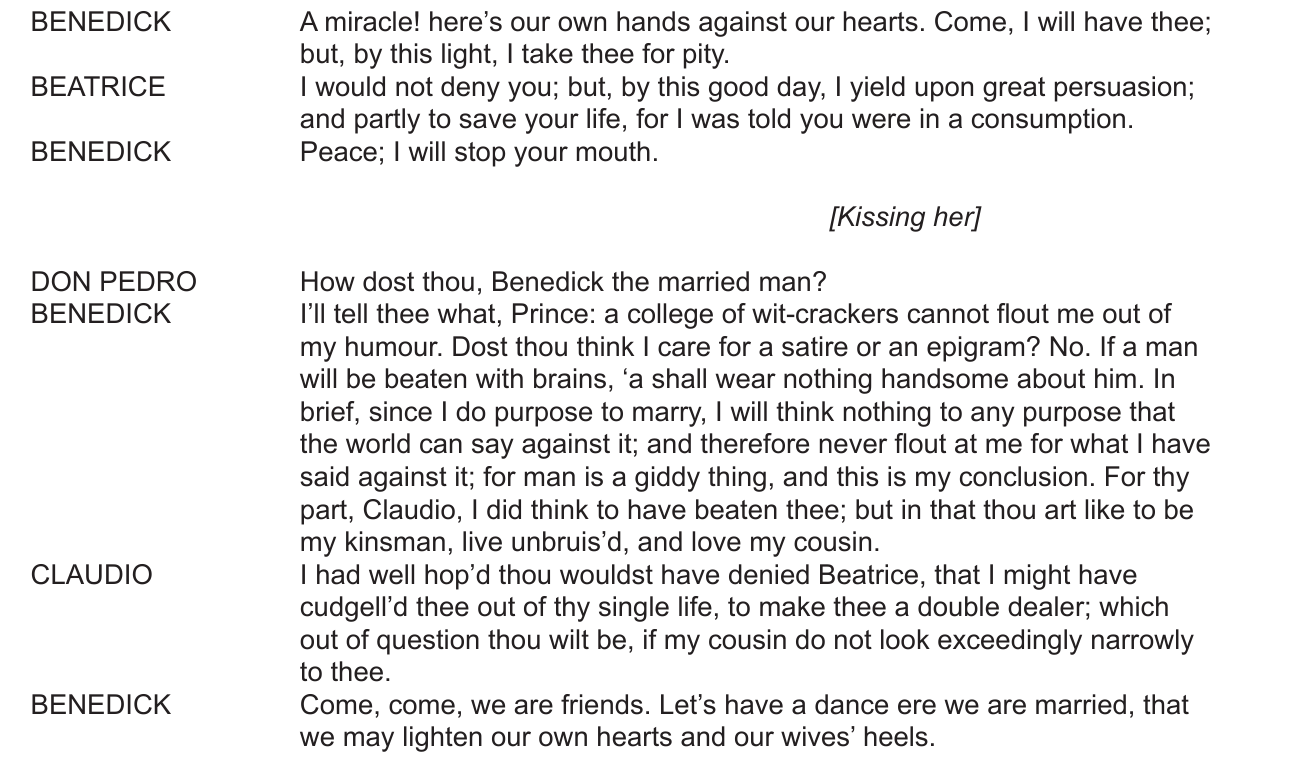
How does Shakespeare present surprises in this play? Refer to this extract from Act 5 Scene 4 and elsewhere in the play.
Write your answer first. You can study the marking guidance whenever you need it.
Study the marking See what earns credit and compare it with a full-mark answer.
Marking points
- 1 Use the complete extract and developed references elsewhere in the play, considering both comic and disruptive surprises.
- 2 Develop a coherent interpretation of what surprises reveal about characters, relationships and the play’s movement towards resolution.
- 3 Analyse dramatic irony, staging, overhearing, repartee, structural reversals or the final kiss for audience effects.
- 4 Integrate relevant context about gender, honour, loyalty or social hierarchy.
- 5 Use accurate spelling and punctuation and controlled vocabulary and sentence structures.
Full-mark answer
Shakespeare uses surprises to expose the gap between what characters think they know and what the audience can see, creating both comedy and pain. In the extract, Beatrice and Benedick are confronted with their written feelings, yet protect themselves through banter: each claims to accept the other from ‘pity’. The stage direction ‘[Kissing her]’ suddenly turns argument into public proof, and Benedick’s ‘man is a giddy thing’ accepts that his earlier certainty about marriage has been overturned. Dramatic irony makes the revelation funnier because their friends and the audience have long understood what the couple denied. Elsewhere, the gulling scenes surprise Beatrice and Benedick into self-knowledge, while Claudio’s quick belief in Hero’s disloyalty shows surprise becoming dangerous. The interrupted wedding shocks both characters and audience, exposing male honour and Leonato’s readiness to trust social expectations over his daughter. Later, Hero’s return and the watch’s unexpected success reverse those assumptions and make reconciliation possible. The conventional society of Messina makes Beatrice’s verbal equality and Benedick’s loyalty to her especially surprising, while gentlemen cause harm and lower-status watchmen uncover truth. Shakespeare therefore makes surprise a comic engine and a moral test: it destabilises false confidence, reveals prejudice, and finally permits characters to become truer to themselves.
Why this answer loses marks
Discuss only the amusing surprise that Beatrice and Benedick love each other.
Broaden the argument to the play’s disruptive surprises—especially the slander, wedding and Hero’s vindication—to show how surprise can expose harm as well as create comedy.